Zwinger, Baroque palace in Dresden, Germany
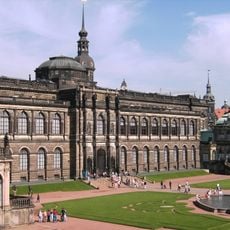
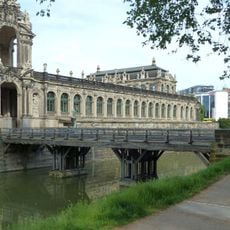
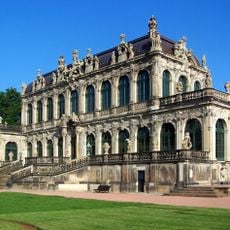
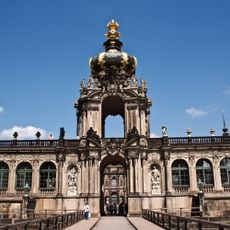
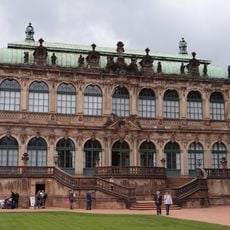
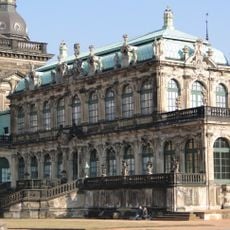
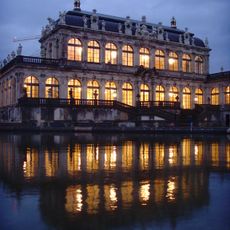
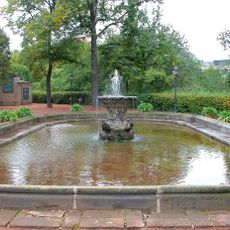
The Zwinger is a Baroque palace complex in Dresden designed by Matthäus Daniel Pöppelmann, with sculpture by Balthasar Permoser. Its walled courtyard is open at the corners, with a single-storey arcaded wing topped by statues and a small domed pavilion at its centre and ends, facing a taller multi-storey wing. Inside, four lawn parterres bordered by low hedges and gravel paths each hold a pool with a fountain.
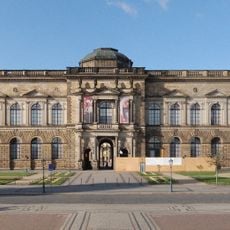
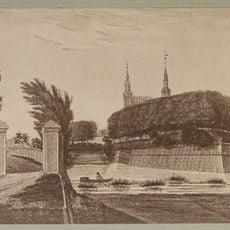
The Zwinger was begun in 1709 as an orangery and festival ground under Augustus the Strong, with plans by Matthäus Daniel Pöppelmann and sculpture by Balthasar Permoser. Work stopped in 1728, leaving the Elbe side open and temporarily walled. Gottfried Semper completed that side with the Semper Gallery, opened in 1855 as a museum. Bombing on 13–14 February 1945 caused heavy damage; reconstruction from the 1950s opened the Old Masters Gallery, Porcelain Collection and Mathematical-Physical Salon.
The name originates from a medieval German term for an area between fortifications, though the building never had a military function. Visitors today encounter collections like the Old Masters Picture Gallery and Porcelain Collection, which transform the space into a place for viewing art and craftsmanship.
The location sits in the heart of Dresden's city center and is easily reached on foot, with several entrances distributed around the complex. The best time to visit is early morning or on weekdays when fewer people are around.
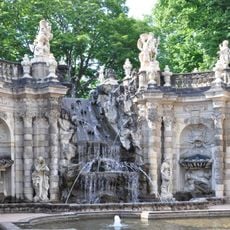
The courtyard is decorated with 698 sculptures, 17 fountains and 1.2 kilometres of balustrade, and a workshop on site carves replacements and maintains the stone figures. The full restoration begun in 1991, estimated at 222 million euros, ended in October 2025 with the handover of the renewed courtyard.
The community of curious travelers
AroundUs brings together thousands of curated places, local tips, and hidden gems, enriched daily by 93,339 contributors worldwide.