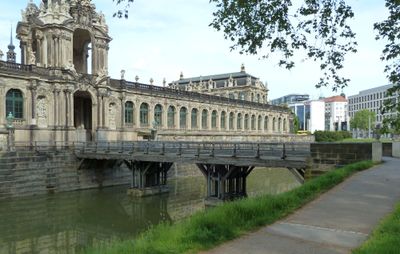
Wallgrabenbrücke, Wooden bridge at Fortress Dresden, Germany
The Wallgrabenbrücke is a short footbridge from the Ostra-Allee over the Zwingergraben to the Kronentor of the Zwinger. Its flat deck carries a plain railing of thin vertical and horizontal wooden members, and the span rests on dark, weathered timber trestle piers standing in the stone-lined channel. The present structure is not pure wood: steel beams, timber and masonry are all clad in wood.
The first bridge was finished in 1718 after Minister August Christoph von Wackerbarth overruled Matthäus Daniel Pöppelmann's stone design, so it could be dismantled in an attack. It was removed in 1759/60 during the Seven Years' War, rebuilt in 1770, taken down again in 1780 and demolished in the 1820s when the moat was filled. Rebuilt in 1929/30, it was largely destroyed in the 1945 air raids and reconstructed in 1949/50, opening in June 1951.
The bridge served as a discrete exit route for royal carriages heading to the countryside, showing the mobility needs of Dresden's court. It reflected the connection between the fortress and the rural areas beyond.
The bridge carries pedestrians from the Ostra-Allee over the partially re-excavated Zwingergraben to the Kronentor of the Zwinger. It is a short crossing, and the deck is edged by a simple wooden railing. The 2021–2025 Zwinger restoration uncovered three sandstone floor slabs from the Kronentor's construction period of 1713–1715, lying 45 cm lower than the previous passage; the planned new bridge will therefore sit somewhat lower.
Unlike architect Matthäus Pöppelmann's original stone design, this wooden structure was deliberately built to be taken apart quickly during wartime. This allowed the fortress to rapidly block access across the moat and defend against attackers.
The community of curious travelers
AroundUs brings together thousands of curated places, local tips, and hidden gems, enriched daily by 92,749 contributors worldwide.