Staatsschauspiel Dresden, State theatre in Wilsdruffer Vorstadt, Dresden, Germany
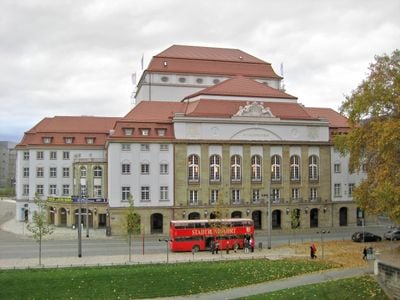
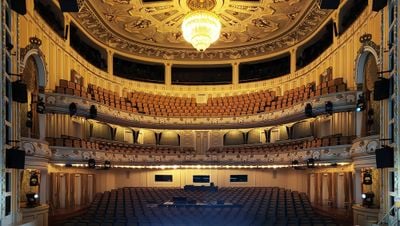
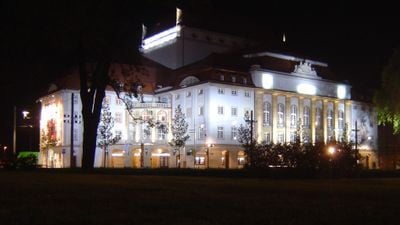
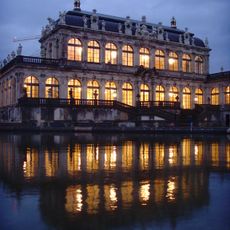
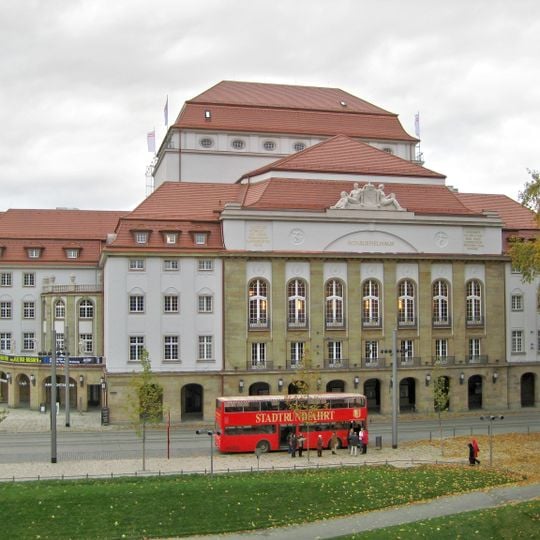
Staatsschauspiel Dresden is a theatre on Ostra-Allee opposite the Zwinger, built 1911–1913 by William Lossow and Max Hans Kühne in Neo-Baroque and Art Nouveau style. Its pale stone facade carries the inscription "STAATSSCHAUSPIELHAUS" beneath a curved pediment with three sculpted figures; the auditorium seats 1312 and is covered by a painted dome with a crystal chandelier.
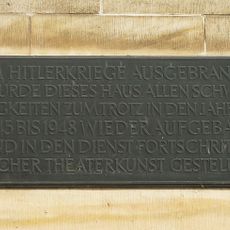
The Dresden bourgeoisie founded a theatre association in 1909, raising about 2.7 million marks for the building, erected 1911–1913 by William Lossow and Max Hans Kühne. It opened on 13 September 1913 as the Neues Königliches Schauspielhaus with Weber's Jubelouvertüre and Kleist's Robert Guiskard. Destroyed in the February 1945 air raids, it was rebuilt and reopened within three years, the first German theatre to do so after the war.
The theatre's name derives from its operator, the Free State of Saxony, which maintains it as part of the Sächsische Staatstheater. Its ensemble numbers 44 actors in the 2024/25 season, and 210,000 visitors attended performances that season, filling 75.6 percent of seats. The Kleine Haus serves as the studio stage alongside the main Schauspielhaus.
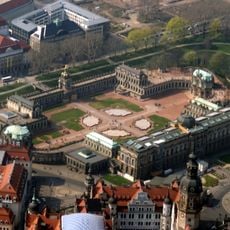
The Schauspielhaus stands on the Ostra-Allee directly opposite the Zwinger, a short walk from the Altstadt. The site between neighbouring buildings left no room for side or rear stages, so the stage machinery sits within the main block. The Kleine Haus is the second venue of the Staatsschauspiel.
During the February 1945 air raids, machine master Franz Lommatzsch had lowered the hydraulic stage platforms to their lowest position at every alarm, so much of the stage machinery survived the destruction of the auditorium.
The community of curious travelers
AroundUs brings together thousands of curated places, local tips, and hidden gems, enriched daily by 94,051 contributors worldwide.