Neroberg, Summit in Wiesbaden, Germany
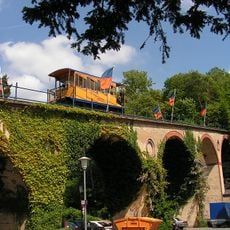
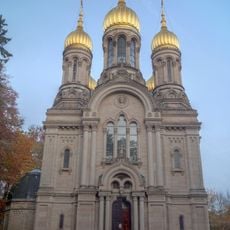
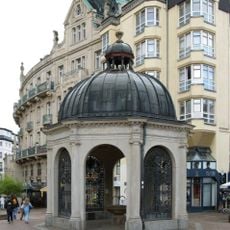
Neroberg is a 245-metre hill at the northern edge of Wiesbaden, rising 130 metres above the Schlossplatz. Its summit holds a park laid out in 1851 by Philipp Hoffmann, with a monopteros whose columns once carried Wilhelmstrasse's oil lamps, and the five gilded cupolas of the Russian Orthodox church built 1847–1855. The Nerobergbahn funicular, running since 1888, climbs from the Nerotal.
The Russian Orthodox Church with five gilded cupolas was built between 1847 and 1855 by Duke Adolph of Nassau as a burial church for his wife Elisabeth Mikhailovna, a niece of Tsars Alexander I and Nicholas I. The adjacent Russian Orthodox cemetery was established in 1856; the painter Alexej von Jawlensky (1865–1941) is buried there. The water-ballast funicular, the Nerobergbahn, has run from the Nerotal since 1888.
The five gilded domes belong to the Russian Orthodox Church of Saint Elizabeth, built 1847–1855 by Duke Adolph of Nassau as a burial church for his wife Elisabeth Mikhailovna, a niece of Tsars Alexander I and Nicholas I. Beside it lies the Russian Orthodox Cemetery of 1856, where the painter Alexej von Jawlensky (1865–1941) is buried.
The funicular railway runs regularly throughout the day and is the easiest choice for visitors who prefer not to walk. Well-marked hiking trails lead through natural forest areas, allowing you to choose based on your fitness level and available time.
The Nerobergbahn has no motor: the upper car's tank is filled with up to 7,000 litres of water, and its descent pulls the other car up. The track uses three rails, with a shared middle rail and a rack beneath the handbrake.
The community of curious travelers
AroundUs brings together thousands of curated places, local tips, and hidden gems, enriched daily by 93,170 contributors worldwide.