Weidendammer Bridge, Steel arch road bridge in Berlin-Mitte, Germany
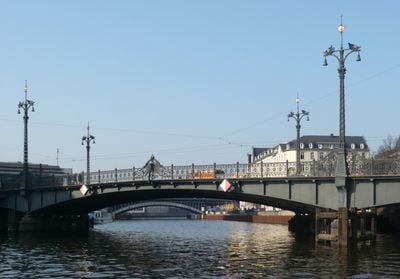
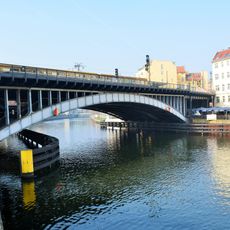
Weidendammer Bridge carries Friedrichstrasse over the Spree on a three-span steel deck bridge with continuous trusses, 73 metres long and 22.5 metres wide. Its dark grey steel arch springs from stone-coloured abutments, and the deck has ornate wrought-iron railings with vertical balusters and decorative panels. Rows of multi-armed lamp posts with rounded glass globes line the roadway, and diamond-shaped white signs with a red border and dark diagonal stripe hang on the outer parapet.
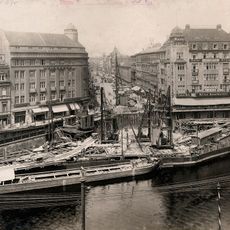
Built between 1895 and 1896 by engineer Otto Stahn, it replaced a cast iron predecessor from 1824, which itself had succeeded an earlier wooden drawbridge from 1685. The structure survived the 1945 Battle of Berlin and remained one of few passable river crossings during those final months of conflict.
The bridge is named after the willow-lined dam on the Spree bank nearby. Couples attach engraved padlocks to the wrought-iron railings, though authorities sometimes remove them. The railings carry imperial eagles at the centre, and the bridge has appeared in Berlin literature.
The bridge carries Friedrichstrasse over the Spree between Mitte and the Spandauer Vorstadt. Trams, cars, bicycles and pedestrians share the deck, so watch for rails and traffic when crossing. The nearest U-Bahn and S-Bahn stops are Friedrichstrasse station, a short walk south, and Hackescher Markt to the north.
On the night of 1 May 1945, a Tiger tank of the 11th SS Panzergrenadier Division Nordland led an attempt to storm the bridge so that hundreds of German soldiers and civilians could escape across it. The next day, Martin Bormann, Hitler's secretary, crossed under fire in the last hours of his life.
The community of curious travelers
AroundUs brings together thousands of curated places, local tips, and hidden gems, enriched daily by 93,132 contributors worldwide.