Zinkenkopf, Mountain summit on the German-Austrian border in Berchtesgadener Land, Germany
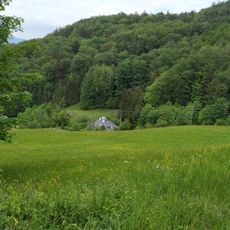
The Zinkenkopf is a 1,336-metre summit on the German-Austrian border, the northern pre-summit of the Roßfeld ridge in the Göll massif. Its peak is built of Upper Jurassic Oberalm beds, while its eastern flank exposes Lower Cretaceous sandy marl of the Roßfeld beds. From the Salzach valley it appears as a small, distinct pyramid.
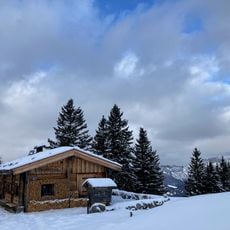
The summit is built of Oberalm beds, a clayey limestone about 150–145 million years old, with sandy marl of the Lower Cretaceous on its eastern flank. The ski area developed on the north slope, where the Zinken double chairlift and several drag lifts now stand; the Keltenblitz summer toboggan run opened in August 2000.
The mountain serves as a recognizable landmark for people living in nearby Hallein, Bad Dürrnberg, and Oberau who see it regularly. A small museum housed in the Zinkenstüberl documents the region's skiing culture and mountain heritage.
Four ski lifts on the Austrian side and one on the Bavarian side provide access to hiking trails and winter sports facilities. Visitors should be prepared for changing weather conditions at elevation during any season.
The mountain is home to the region's longest summer toboggan run, which has operated since 2000. A transmission station at the summit broadcasts radio and television signals to the surrounding area.
The community of curious travelers
AroundUs brings together thousands of curated places, local tips, and hidden gems, enriched daily by 94,922 contributors worldwide.