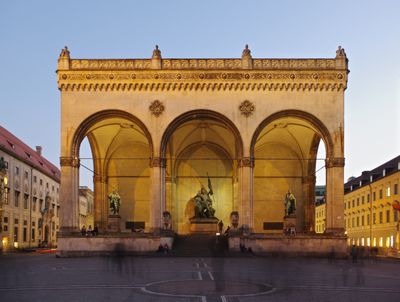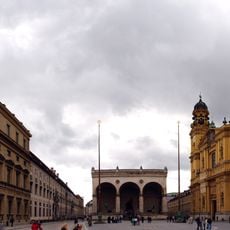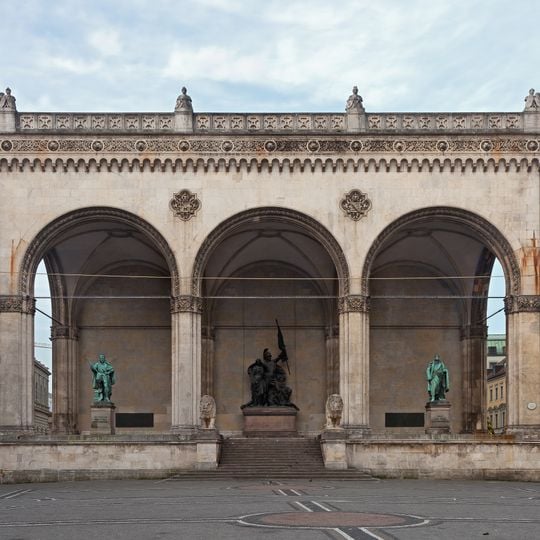
Feldherrnhalle, Neoclassical loggia at Odeonsplatz, Munich, Germany
The Feldherrnhalle is a Neoclassical open loggia of Kelheim limestone at Odeonsplatz, modelled on Florence's Loggia dei Lanzi. Three round arches rest on four columns whose square bases carry carved lions, and a frieze of circular ornaments runs above them below a balustrade with statues. Bronze figures stand in the arches: Tilly and Wrede to the sides, the Army Monument with raised flag in the centre.
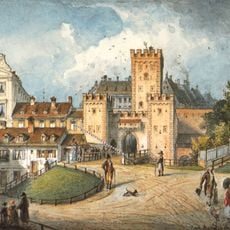
Built 1841–1844 by Friedrich von Gärtner for King Ludwig I, the hall replaced the Gothic Schwabinger Tor and its neighbouring inn, the Bauerngirgl, at the south end of the new Ludwigstrasse. Gärtner modelled it on Florence's Loggia dei Lanzi but raised the steps to make it look more monumental. It was dedicated to the Bavarian army and answers the Siegestor a kilometre away. War damage was repaired between 1950 and 1962; a full restoration began in March 2025.
Munich residents have long mocked the two field marshals honoured here: Tilly was never really a Bavarian, and Wrede, the saying goes, was never really a Feldherr. The quip comes from Lion Feuchtwanger's novel Erfolg. The bronze figures were designed by Ludwig von Schwanthaler and cast by Ferdinand von Miller in 1844.
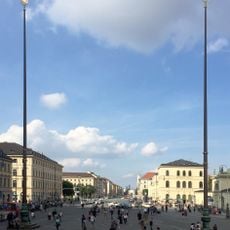
The hall closes the south end of Odeonsplatz, where Ludwigstrasse begins; U3, U4, U5 and U6 stop at Odeonsplatz station. The open loggia can be entered from the square, and the Viscardigasse lane runs behind it past the Palais Preysing. A general renovation started in March 2025 and is scheduled to last three years, so parts may be screened off.
A narrow passage behind the structure, called Drückebergergasse, allowed people to avoid performing mandatory salutes during the 1930s and 1940s. This hidden route became a quiet form of everyday resistance to enforced compliance.
The community of curious travelers
AroundUs brings together thousands of curated places, local tips, and hidden gems, enriched daily by 92,829 contributors worldwide.