Rosenstein Castle, Classical palace in Bad Cannstatt, Germany
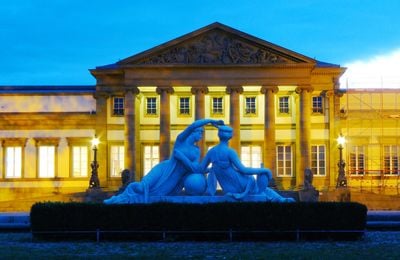
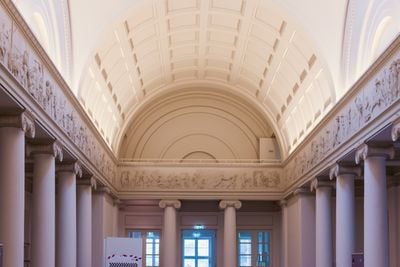
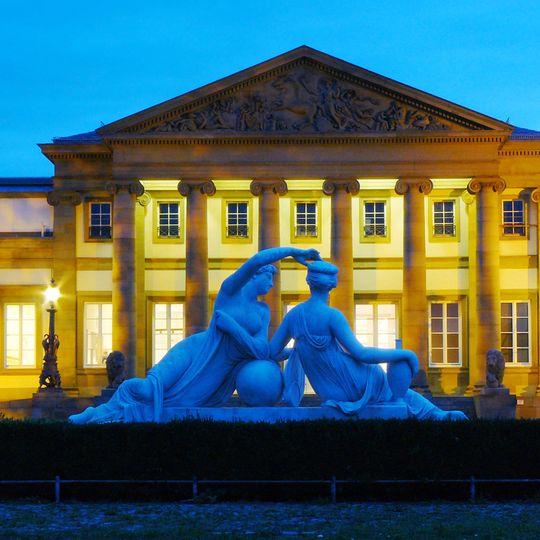
Rosenstein Castle is a classical palace built for King Wilhelm I of Württemberg, standing on the former Kahlenstein hill at the eastern end of Rosenstein Park. Its front has a portico of six columns under a triangular pediment filled with relief sculpture, with five upper and five larger lower windows behind. Inside, a coffered barrel vault in cream-colored material sits above a band of relief sculpture showing figures and animals, carried by smooth columns.
Giovanni Salucci built Rosenstein Palace for King Wilhelm I of Württemberg between 1824 and 1829 as a summer residence, though the king never lived there permanently. From 1877 to 1918 it held the king's painting and sculpture collection, then from 1921 the World War Library and from 1933 also a war museum. Badly damaged in 1944, it was rebuilt in the 1950s; only Conrad Weitbrecht's Four Seasons frieze survived of the interior decoration.
The castle houses sections of the State Museum of Natural History Stuttgart, where visitors can explore exhibits about animals, plants, and minerals found in the region. The collections show how nature appears locally and what creatures make their home here.
The castle is easily accessible by public transportation and sits within a park where visitors can stroll before or after their visit. Guided tours run regularly and help guests learn more about the exhibitions and the site's background.
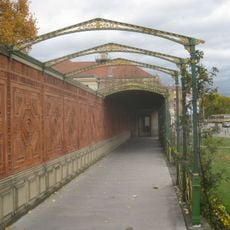
Beneath the castle runs a historic railroad tunnel from the 1800s, which was once the first of its kind in Württemberg. The tunnel was built to carry the railway under the building, showing how architecture and transportation were integrated during that era.
The community of curious travelers
AroundUs brings together thousands of curated places, local tips, and hidden gems, enriched daily by 94,490 contributors worldwide.