Lilienthal Observatory, Astronomical observatory in Lilienthal, Germany.
Lilienthal Observatory was founded in 1782 by Johann Hieronymus Schroeter as a private research observatory in the village of Lilienthal near Bremen. In 1786 he built a two-storey observatory in the garden of the Amt house, with a terrace on the lower level onto which telescopes could be rolled and sliding roof flaps on the upper floor. About 70 metres away stood the octagonal wooden "Urania Temple" of 1788. The buildings were demolished by 1850; a local heritage museum displays original telescopes and a model of the giant telescope.
Johann Hieronymus Schroeter, Oberamtmann of Lilienthal, began observing in his garden in 1782 and built a two-storey observatory there in 1786. In 1793–1794 he completed a 50.8 cm reflector with 8.25 m focal length, which made the site internationally known. In 1800 he co-founded the Astronomische Gesellschaft with Franz Xaver von Zach and Heinrich Wilhelm Olbers. French troops burned the village in April 1813; the observatory was spared but looted, and its last remains were demolished in 1850.
In 1800 Schroeter founded the Astronomische Gesellschaft in Lilienthal together with Franz Xaver von Zach and Heinrich Wilhelm Olbers. The observatory drew astronomers, senior officials and officers of various armies, and its 50.8 cm giant telescope made it known beyond Germany. Karl Ludwig Harding discovered the asteroid Juno here in 1804, and Friedrich Wilhelm Bessel worked as an assistant from 1806 to 1809.
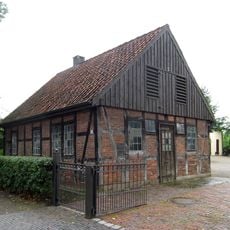
The observatory building was demolished in 1850; what visitors reach today is the Heimatmuseum in Lilienthal, where original telescopes are displayed, plus an outdoor model of the giant telescope. Since November 2015 a working replica of the 27-foot reflector of 1793 stands at the village entrance opposite the Borgfelder Landhaus, the Telescopium Lilienthal. Check the museum's opening times before travelling.
The 50.8 cm mirror of the 1794 giant telescope was cast and ground in Lilienthal by Schroeter with his gardener Harm Gefken and Professor Johann Gottlieb Friedrich Schrader of Kiel, who from 1792 worked on ways to improve metal mirrors. A working replica of the 27-foot instrument, the Telescopium Lilienthal, has stood at the town entrance opposite the Borgfelder Landhaus since November 2015.
The community of curious travelers
AroundUs brings together thousands of curated places, local tips, and hidden gems, enriched daily by 93,578 contributors worldwide.