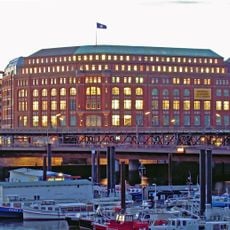
Überseebrücke, Footbridge in Port of Hamburg, Germany.
The Überseebrücke is a covered pedestrian bridge leading from the Jan-Fedder-Promenade flood barrier on Vorsetzen street to a pontoon in Hamburg's Niederhafen, east of the St. Pauli-Landungsbrücken. It is about 119 metres long and was assembled from five parts, including a wooden-clad entrance building with two kiosks, a central arch section from the 1898 Fährkanal landing, and a southern end rebuilt after a 1961 collision. The east side is open, while the west side is closed with plexiglass panels.
The Überseebrücke was built in 1927 for the Hamburg Süd shipping company by the steel construction firm H. C. E. Eggers & Co., then called Blockhausbrücke, as a landing stage for passenger ships bound overseas. It was a steel arch structure almost 119 metres long reaching into navigable water. Destroyed in the Second World War, it was rebuilt between 1957 and 1968 from older landing stages, and renovated from 2012 to 2015.
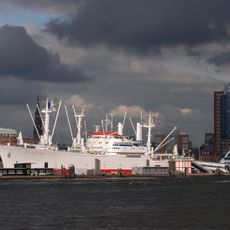
Visitors walk across this structure to reach the museum ship Cap San Diego nearby, where exhibits show the story of shipping and port life. The bridge itself represents how deeply maritime trade shaped the city.
This footbridge is designed for pedestrians and offers a direct route from the harbor to nearby museums and attractions. Wear shoes with good grip, as the walkway can be slippery depending on weather conditions.
The bridge was assembled from reused landing stages: the middle arch comes from the 1898 Fährkanal pier, overhauled at the Janssen & Schmilinsky yard, and the southern end was rebuilt after the Swedish naval ship Marieholm rammed it on 8 June 1961.
The community of curious travelers
AroundUs brings together thousands of curated places, local tips, and hidden gems, enriched daily by 94,905 contributors worldwide.