Agger Dam, Gravity dam in Gummersbach, Germany
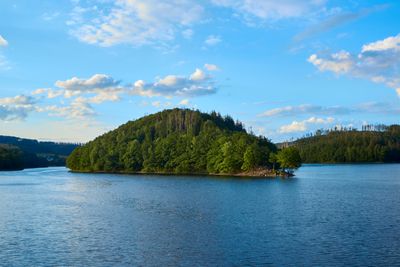
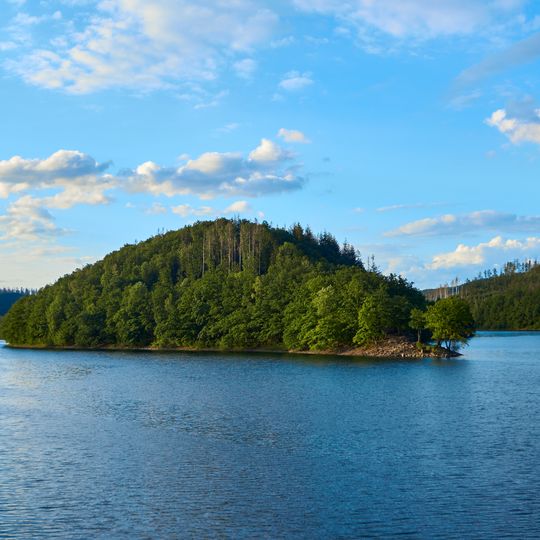
Agger Dam is a gravity dam of cast concrete built between 1927 and 1929, 225 to 230 m long and 45 m high, holding back the Agger, Genkel and Rengse in three valleys. Its reservoir covers roughly 120 to 150 ha and holds 20.5 million cubic metres. In 1967 a 12 cm bitumen layer and a 40 cm concrete layer were cast against the water side, anchored by several thousand anchors.
First proposals for a dam on the Agger above Dümmlinghausen date from 1900–1904, prompted by rising energy demand and annual flood damage. Work ran from 1927 to 1929, with up to 1,600 workers on site; the concrete was chosen over stone for cost reasons. On 10 October 1928 a pouring tower's spout broke and four workers died. Trial impounding began on 24 December 1928, was halted in September 1929 for sealing work, and filling restarted on 18 October 1929.
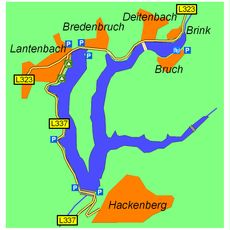
The reservoir takes its name from the Agger, which is joined by the Genkel and Rengse in the flooded valleys. A boat harbour serves sailing and rowing boats, and since 1997 the Tauchsportverband NRW has regulated diving. Divers can see a fully preserved viaduct with an arch they can swim through, a crushing plant and broken-stone walls below the surface.
The dam wall is 225 to 230 m long and 45 m high, with a roadway on the crest widened to 11.60 m in 1967. Trails, rest areas, a youth campsite and a boat harbour for sailing and rowing boats serve visitors. Divers enter at spots regulated by the Tauchsportverband NRW since 1997.
The dam is a gravity wall of cast concrete, not an arch dam. In April 1967 the reservoir was drained because the water side leaked; a 12 cm bitumen layer and a 40 cm concrete layer were cast against the wall, tied by several thousand anchors, and the crest road was widened to 11.60 m.
The community of curious travelers
AroundUs brings together thousands of curated places, local tips, and hidden gems, enriched daily by 93,028 contributors worldwide.