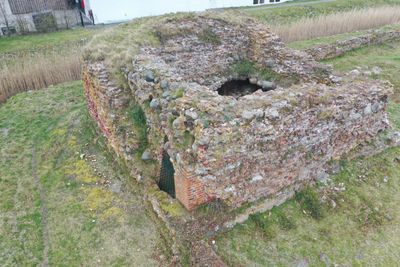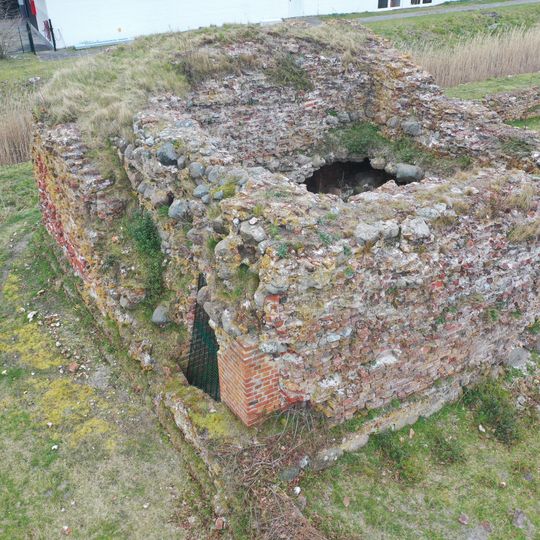
Glambæk, Medieval castle ruins in Fehmarn, Germany.
Glambæk is a castle site on Fehmarn island along the Baltic Sea coast, with only stone walls and foundations from the 13th century remaining. The remains show the original layout of the fortification and provide insight into the architecture and construction of this medieval defensive structure.
Valdemar II of Denmark had the lowland castle built in 1210 on the Burgtiefe peninsula. It was the setting of the 1248 wedding of Christopher, brother of Erik IV, to Margaret Sambiria, and of the 1307 Glambek settlement. Erik of Pomerania destroyed it in 1420; after Christian IV failed to retake it in 1628, its bricks were carried off until sand buried the site, which the 1872 Baltic storm flood washed free again.
The castle gave its name to the Glambeker Vergleich of 1307, when King Erik VI of Denmark mediated between Holstein's counts and the local nobility. In 1320 Christoph II issued the oldest Fehmarn land law here, and his bailiff from the Reventlow family held court and had people hanged in 1321. The site now lies behind a holiday complex near the Südstrand, overgrown and without information panels.
The ruin lies behind a holiday complex near the Südstrand of Burgtiefe, with no proper access path and no information boards. It is overgrown with weeds and hard to find. Approach on foot from the beach area and expect uneven ground.
The castle was largely quarried for its bricks and then buried under drifting sand; the Baltic storm flood of 1872 washed the remains free again, and systematic excavation began in 1908. Today the site lies behind a holiday complex, without proper access paths or information boards, overgrown with weeds.
The community of curious travelers
AroundUs brings together thousands of curated places, local tips, and hidden gems, enriched daily by 93,762 contributors worldwide.