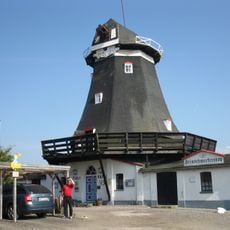
Fehmarn Windmühle Lemkenhafen, Mill museum in Lemkenhafen, Germany.
The Fehmarn Windmill Lemkenhafen is a mill museum housed in an 18th-century windmill building with four large sails visible across the coastal landscape. Inside, three grinding stones process grain, and two attached storage rooms display traditional farm tools, household items, and detailed models of regional farmhouses.
Joachim Rahlff (1756–1830), a grain merchant and shipowner, had the Dutch-type smock mill built in 1787; Fehmarn grain was ground here into groats and pearl barley for export to the Nordic countries. Around 1848 the mill took the name "Jachen Flünk" from a former owner. Milling declined in the early 20th century and stopped in 1954; the state of Schleswig-Holstein took over the building in 1958, restored the machinery and placed it under monument protection.
The name comes from Lemkenhafen, the village on Fehmarn island where the mill has long been part of the local landscape. Inside, visitors see how traditional farm tools and models of regional farmhouses show what daily life looked like for earlier residents.
The mill stands in Lemkenhafen on the island of Fehmarn, in the Ostholstein district of Schleswig-Holstein. Five of the mill's six floors and the adjoining granary were converted into museum rooms between 1964 and 1965, so visitors climb through several storeys to see the machinery, farm models and the fully equipped smithy.
The mill's name, "Jachen Flünk", comes from a former owner and was adopted around 1848, not from the village. Around 1900 five to six journeymen plus helpers worked here. The building was taken over by Schleswig-Holstein in 1958 only after demolition threatened it.
The community of curious travelers
AroundUs brings together thousands of curated places, local tips, and hidden gems, enriched daily by 94,572 contributors worldwide.