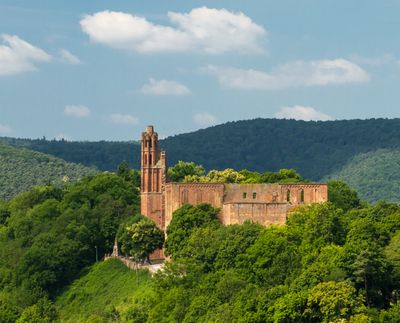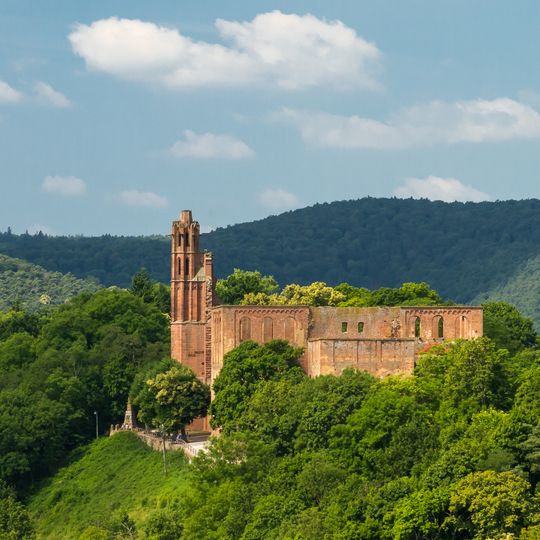
Limburg Abbey, Benedictine monastery ruins on Limburg hill in Bad Dürkheim, Germany.
Limburg Abbey is a ruined Benedictine monastery on the Limburgberg above Bad Dürkheim, built from reddish-brown sandstone. Its long main wall carries a row of tall blind arches, and a narrow tiered tower with vertical openings stands at the left end. The right-hand section is lower, with irregular square openings and no roof.
Building work started in 1025 when the Salian dynasty converted their hilltop fortress into a Benedictine foundation under Emperor Conrad II. The complex gained regional influence before falling into gradual disuse during the 16th century.
The abbey's official name was "Stift zum Heiligen Kreuz" (Foundation of the Holy Cross), reflected in its arms: a black cross on a silver field. A synod held here on 3 December 1038, with Emperor Conrad II present, fixed the rule still used today for dating the Sundays of Advent. The Limburg Madonna, a crowned Mother of God carved around 1300, was found in the 1830s in nearby Grethen.
Access follows an uphill path from the edge of Bad Dürkheim onto the plateau where the ruins spread out across open ground. The site remains walkable even in damp weather, though sturdy shoes help when exploring the uneven stone floors and steps between the standing walls.
The abbey church was consecrated in 1042; its patron was the Holy Cross, reflected in the abbey's arms of a black cross on a silver field. A monk named Gumbert, identified as the builder, briefly served as third abbot in 1035 and his grave slab survives. The Limburg Madonna, a crowned figure dated to around 1300, was found in the 1830s in nearby Grethen.
The community of curious travelers
AroundUs brings together thousands of curated places, local tips, and hidden gems, enriched daily by 92,811 contributors worldwide.