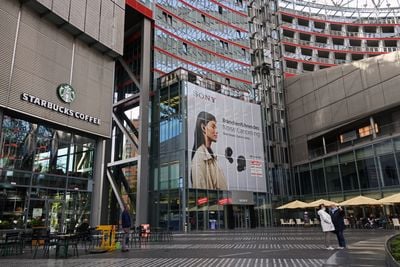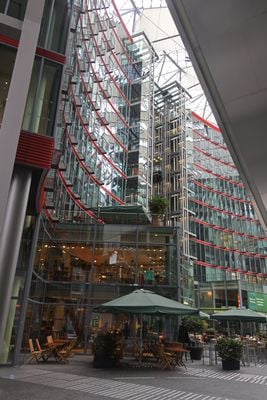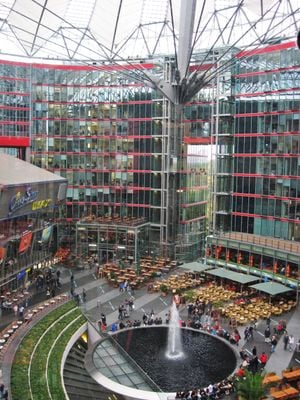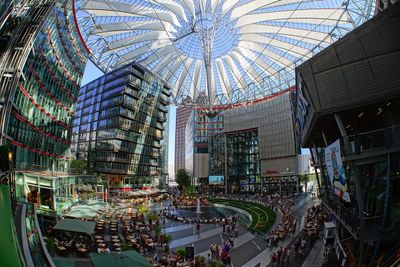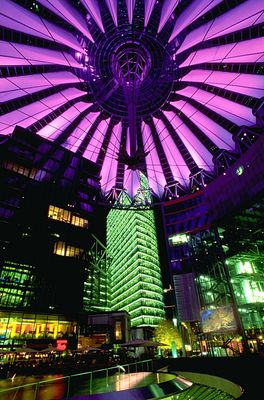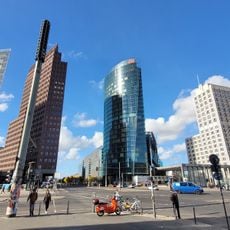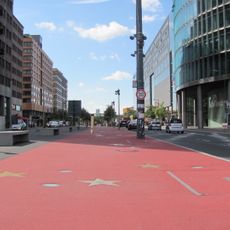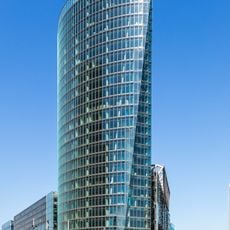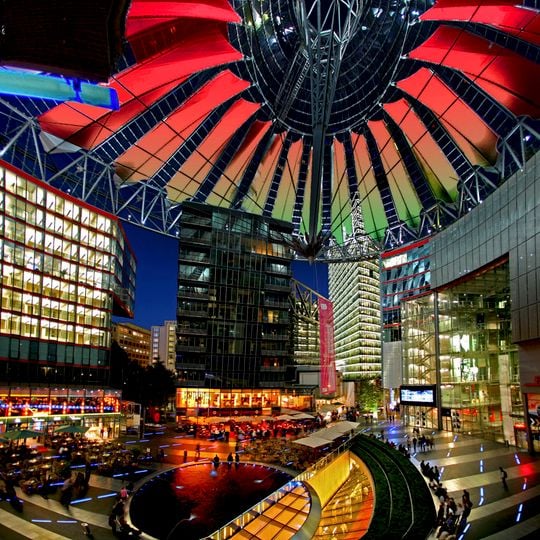
Sony Center, Entertainment complex in Tiergarten, Berlin, Germany
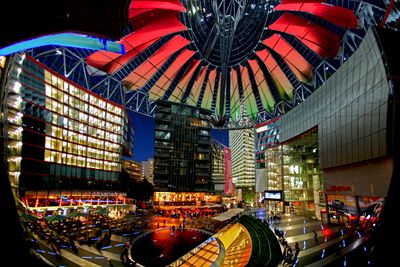
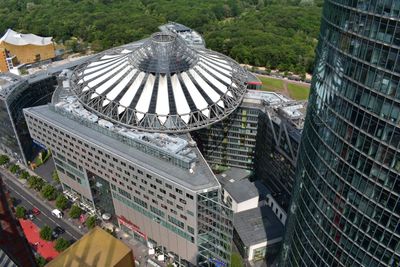
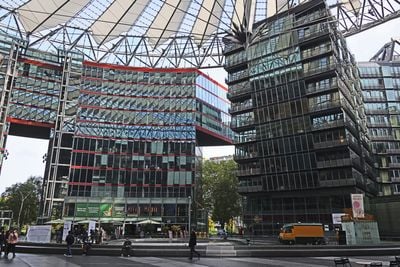
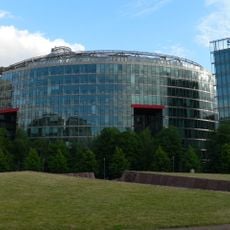
The development comprises several buildings arranged in a circular layout around a central courtyard, covered by a distinctive glass and steel canopy that illuminates in different colors at night and remains visible from Potsdamer Platz and surrounding streets.
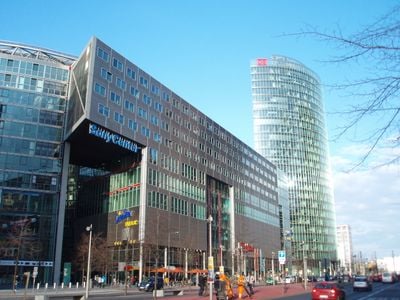
Architect Helmut Jahn designed this commercial ensemble that opened in 2000 on terrain previously occupied by the Berlin Wall's death strip, located near Potsdamer Platz which underwent comprehensive redevelopment following German reunification.
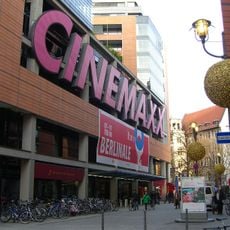
This commercial development functions as a gathering point with multiple cinema screens including an IMAX theater, dining establishments, and event facilities that host international film premieres during the Berlinale and other occasions throughout the calendar year.
Underground passages connect the site directly to public transportation networks, while parking facilities, retail shops, and office spaces for international corporations remain accessible to visitors during regular business hours throughout the week.
A comprehensive renovation project launched in 2023 with a 200 million euro investment temporarily changed the name to Center am Potsdamer Platz as ownership reconsidered the original branding following corporate restructuring decisions.
Location: Bezirk Mitte von Berlin
Inception: 1996
Architects: Helmut Jahn
Architectural style: high-tech architecture
Made from material: steel, glass
Website: http://sonycenter.de
GPS coordinates: 52.51000,13.37361
Latest update: December 1, 2025 11:42
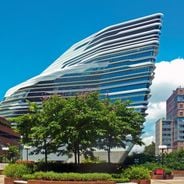
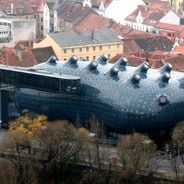
Architecture does not have to follow straight lines and right angles. This collection presents buildings that stand out through their form: domes, spirals, tilted facades or organic structures that recall animals or plants. From Gaudí's mosaic covered works in Barcelona to the stacked concrete cubes of Habitat 67 in Montreal or the conical trulli of Alberobello, these structures demonstrate alternative approaches to construction. Some emerged from technical necessity, such as the temporary cardboard cathedral in Christchurch after the 2011 earthquake. Others are artistic statements: the Guggenheim Museum in Bilbao with its titanium plates, the Dancing House in Prague or the cubist houses in Rotterdam. In Đà Lạt, the Crazy House transforms tree trunks and caves into habitable spaces, while the Atomium in Brussels represents a magnified iron crystal. These structures attract visitors but also raise questions about function and livability. The Longaberger Basket Building in Ohio takes the form of a seven story basket. The Lotus Temple in New Delhi uses concrete shells to form 27 petals. The Aldar headquarters in Abu Dhabi resembles a circular coin. These buildings expand the definition of what architecture can be.
Postmodern architecture emerged in the 1970s as a response to the rigid principles of modernism, reintroducing color, ornament, and historical references into contemporary building design. The movement evolved over decades, producing structures that challenge conventional forms and experiment with different materials and surfaces. These buildings demonstrate varied approaches to design, from playful facades to complex geometric constructions, showing how architects employ new technologies while engaging with historical stylistic elements. The collection includes cultural institutions such as the Guggenheim Museum Bilbao and Casa da Música in Porto, public buildings like Seattle Central Library and Almere City Hall, and religious structures such as the Jubilee Church in Rome. Other examples include the SIS Building in London, Dancing House in Prague, and Niterói Contemporary Art Museum in Rio de Janeiro. The Louvre Pyramid in Paris and the Wexner Center for the Arts in Columbus show different interpretations of postmodern principles. The Piazza d'Italia in New Orleans with its colored colonnades and the Portland Building with its decorated facade represent early postmodern works in the United States.
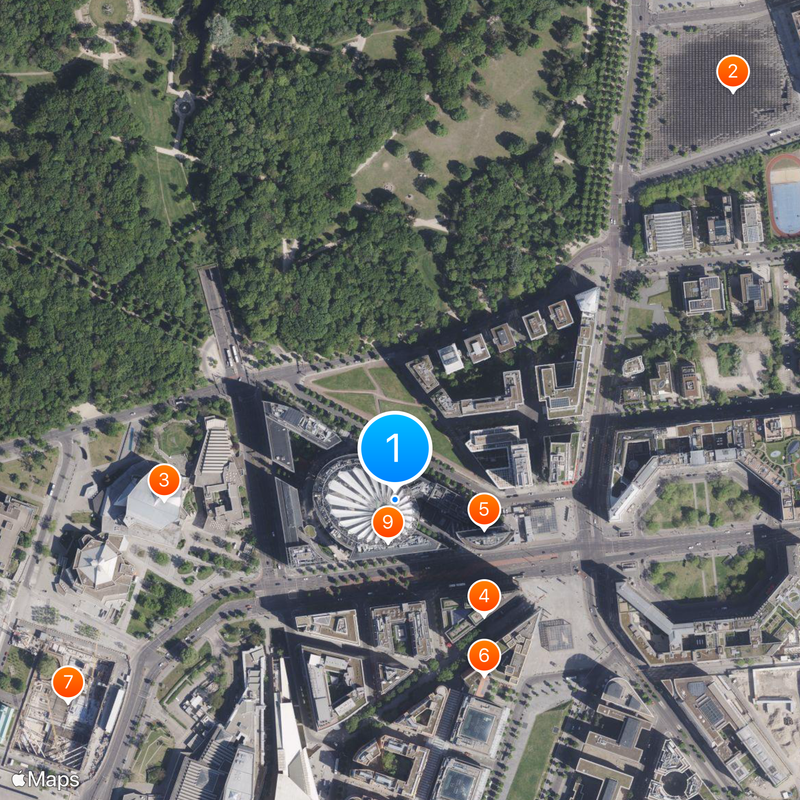
Memorial to the Murdered Jews of Europe
561 m
Berliner Philharmonie
245 m
Kollhoff Tower
154 m
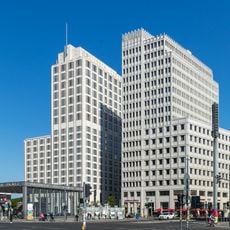
BahnTower
240 m
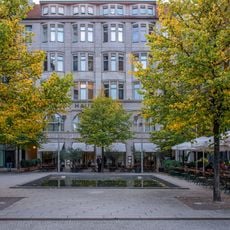
Haus Huth
208 m
Berlin modern
135 m
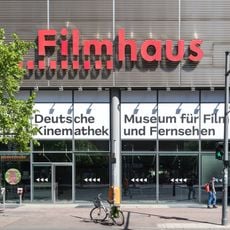
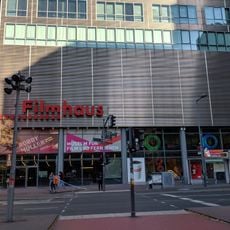
Museum of Film and Television Berlin
45 m
Deutsche Kinemathek
45 m
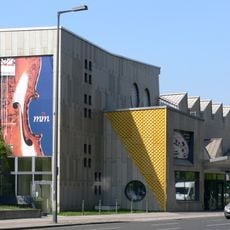
Berlin Musical Instrument Museum
187 m
Beisheim Center
140 m
Vox-Haus
163 m
The Boxers
184 m
Lessing Monument
231 m
Arsenal
71 m
Rolandbrunnen
231 m
Legoland Discovery Centre Berlin
111 m
Deutsche Kinemathek
50 m
Haus Wallich
90 m
Henriette-Herz-Park
112 m
Fontaneplatz
230 m
Panoramapoint
152 m
Orpheus
235 m
Potsdamer Platz S-Bahn station
213 m
Arsenal
50 m
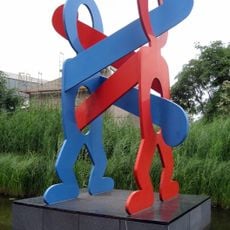
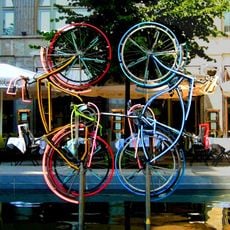
Riding Bikes
230 m
Deutsche Kinemathek - Museum für Film und Fernsehen, Bibliothek
53 m
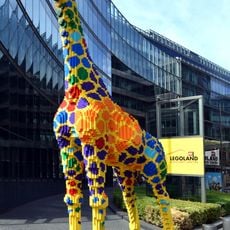
Lego-Giraffe
87 m
Phoenix
169 mReviews
Visited this place? Tap the stars to rate it and share your experience / photos with the community! Try now! You can cancel it anytime.
Discover hidden gems everywhere you go!
From secret cafés to breathtaking viewpoints, skip the crowded tourist spots and find places that match your style. Our app makes it easy with voice search, smart filtering, route optimization, and insider tips from travelers worldwide. Download now for the complete mobile experience.
A unique approach to discovering new places❞
— Le Figaro
All the places worth exploring❞
— France Info
A tailor-made excursion in just a few clicks❞
— 20 Minutes