Babilonie, Archaeological site and cultural heritage monument in Obermehnen, Germany.
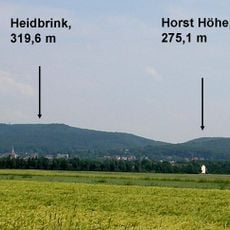
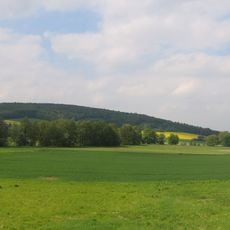
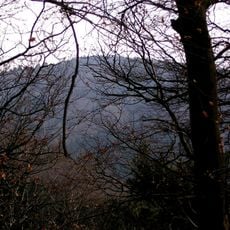
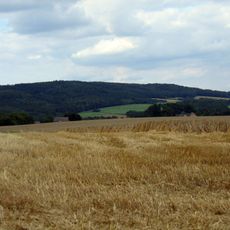
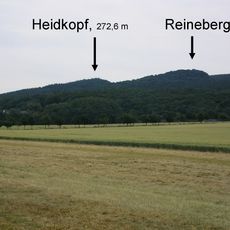
Babilonie is a hillfort of the La Tène culture on a 255.6-metre-high hill in the Wiehen Hills above Obermehnen. Its wedge-shaped rampart system descends from south to north with the slope and encloses over 12 hectares. The walls follow the east flank for 750 metres and the west flank for 450 metres, with three staggered lines on the 550-metre-long north side.
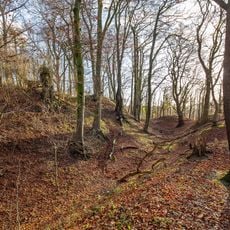
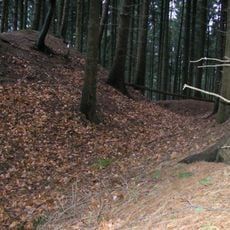
The Babilonie's ramparts were built in several phases. The earliest earthwork, a simple wall without a ditch, enclosed the hilltop and its spring in the pre-Roman Iron Age; a second line followed, then a 5 m wide, 1.90 m deep V-shaped ditch was cut in front of a raised outer rampart, dated by pottery to the 5th–7th century. A later core work with a 4 m ditch and a pincer gate is placed in the Carolingian-Ottonian period. Excavations were led by Friedrich Langewiesche in 1905, 1929/30, 1936 and 1939, Walter Lange in 1952 and Klaus Günther in 1981; when the site was abandoned is still unresolved.
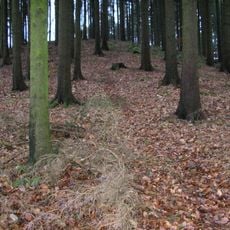
The ramparts and earthen mounds remain visible today, showing how inhabitants engineered their settlement to control the surrounding territory. Walking through the site gives a sense of the practical thinking behind their choice to build on this elevated ridge.
The site sits at an elevated position and can be reached on foot via marked trails from the nearby village. Wear sturdy shoes since the paths cross uneven terrain and can be muddy or slippery depending on recent weather.
The name Babilonie is only recorded since 1723 and its origin is disputed; one suggestion links it to "Babelönje/Babenlon", a term for mountain forest. A connection with Charlemagne's Saxon wars, when the Frankish royal annals report a battle at Hlidbeki (Lübbecke) in 775, is often assumed but not proven.
The community of curious travelers
AroundUs brings together thousands of curated places, local tips, and hidden gems, enriched daily by 93,828 contributors worldwide.