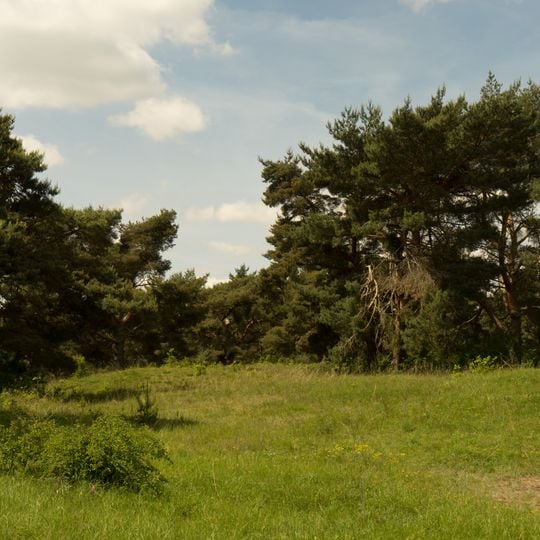
Mainzer Sand, Nature reserve in Mainz, Germany.
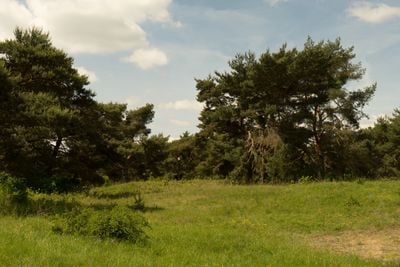
The Mainzer Sand is a 127-hectare inland dune reserve between Gonsenheim and Mombach, its calcareous white sand supporting dry steppe grassland. A line of tall pines marks the edge where the open sand meets the adjoining Lennebergwald; one tree on the right has dead bare branches among green needles. Low shrubs grow at the lower left of the grass field.
The dunes formed after the last ice age, with wind-blown sand from the Rhine valley deposited before 13,000 years ago and steppe plants arriving around 12,000 years ago. From 1798 the area was used militarily, first by French troops (1799–1814), then by Prussian and Austrian forces of the Mainz fortress. Later the Wehrmacht and, after World War II, French and American troops used it; parts remain a US training area.
The area attracts visitors seeking to experience rare plant communities and open landscapes typical of grassland ecosystems. Walking through it offers a chance to see how nature adapts to sandy, dry conditions in a region usually known for forests and cultivated land.
The reserve can be accessed through marked paths, though certain sections remain restricted to protect the delicate ecosystems and rare plant species found there. Visitors should stay on designated trails to avoid damaging the fragile natural balance.
The sand orcanette (Onosma arenaria) survives in Germany only here, in a few specimens, on lime-rich white sand that barely holds water. The site also shelters steppe plants otherwise found in the Hungarian Puszta and further east, many of them on the Red List.
The community of curious travelers
AroundUs brings together thousands of curated places, local tips, and hidden gems, enriched daily by 93,751 contributors worldwide.