Blausteinsee, Artificial lake and recreation area in Eschweiler, Germany
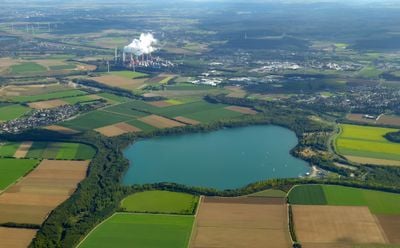
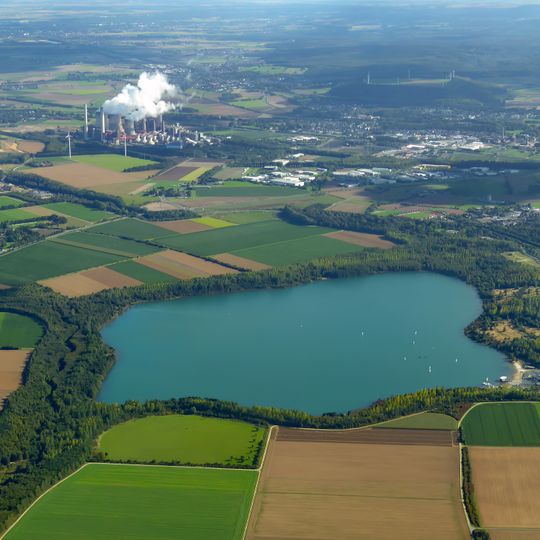
Blausteinsee is an artificial lake north of Eschweiler in North Rhine-Westphalia, Germany, created by flooding the remaining pit of the Zukunft brown coal opencast mine. Its opaque turquoise water covers about 100 hectares, reaches up to 46 metres deep and is bordered on all sides by a green belt of trees and shrubs, with small white sails and thin posts scattered across the surface.
The Zukunft-West opencast mine yielded its last of 530 million tons of brown coal in 1987, and the final machinery left the pit in early 1994. On 5 October 1994, filling began with a fountain in the lake's centre, about 500 m from shore, spraying roughly 210 litres per second to a height of 40 m. The lake was officially opened on 12 August 2000 and reached its final area of about 100 hectares and maximum depth of 46 m in 2005.
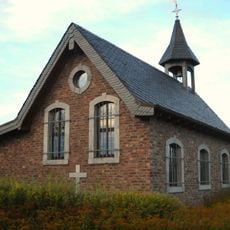
The name refers to the old district 'Am blauen Stein' north of Dürwiß, named after a 17th- or 18th-century wayside cross on the road between Dürwiß and Fronhoven. The lake is used by sailing, diving and rowing clubs, and the Erich-Berschkeit-Pokal regatta is held here annually. Memorial stones and wayside crosses around the shore recall the villages excavated for the mine.
The area stays open year-round, though summer months draw most visitors who come to swim in the clear water. Several paths circle the shore and offer different views of the water and surrounding woodland.
The diving zone lies on the northwest shore, not the west, and the sunken objects are deliberate attractions: a Unimog, a wrecked dinghy, an angel figure and trees. The Eschweiler diving club made an underwater map of them. Visibility depends on the sandy bed and the number of divers, ranging from one to seven metres, and is best below 25 metres.
The community of curious travelers
AroundUs brings together thousands of curated places, local tips, and hidden gems, enriched daily by 93,823 contributors worldwide.