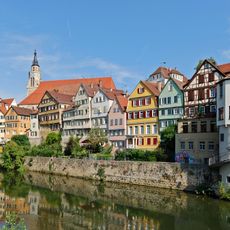
St. George's Collegiate Church, Gothic church in Tübingen, Germany
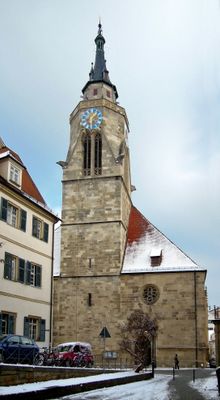
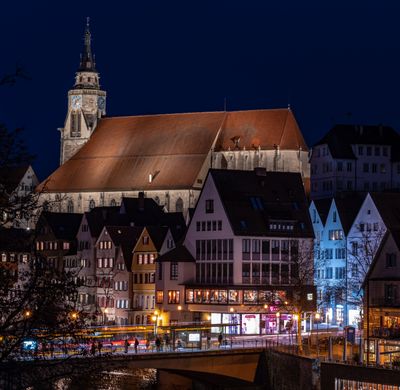
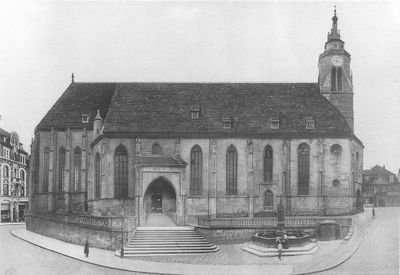
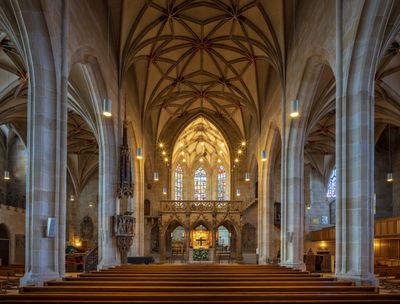
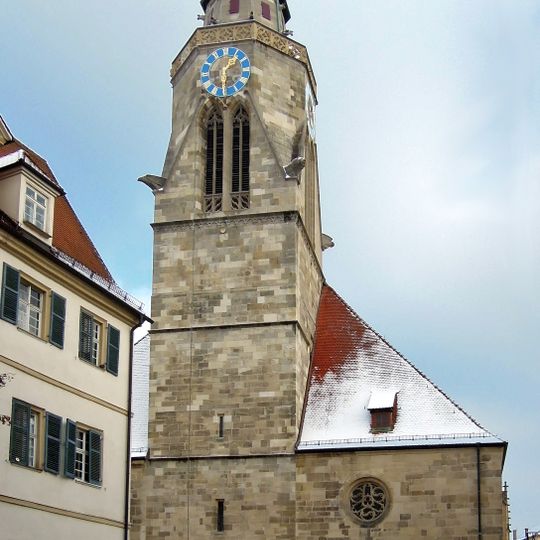
St. George's Collegiate Church is a late Gothic hall church with a single west tower topped by an open pointed spire and clock face. Its pale stone body has tall pointed windows and a steep red tiled roof, with a round rose window on the lower right wall. Inside, the nave and aisles are covered by a net rib vault of cement and clay ribs with tuff infill.
The tower was begun in 1411 and the choir from 1470, attributed to Peter von Koblenz; the nave followed from 1478 under Hans Augsteindreyer and was finished around 1490. The collegiate foundation was dissolved in 1534 during the Reformation, and the church became Tübingen's parish church again in 1537. From 1550 the choir served as the burial place of the Württemberg ducal family, and Georg Beer completed the tower with its wooden spire in 1590.
The name honours Saint George, a protector figure venerated across medieval Europe whose cult held particular importance in these lands. Walking inside, visitors encounter carved memorials and artworks that shaped how generations understood faith and power in this region.
The church is within walking distance from the main square and sits in the heart of the old town. Visitors should be aware that regular worship services take place, which may limit access at certain times.
The tower was begun in 1411, before the rest of the present church, and reached the bell stage by 1468. Its wooden spire was only added in 1590 by Georg Beer. The roof timbers of the nave were felled in the Black Forest in 1487–1489 and floated down the Neckar; the rafting marks, Floßaugen, can still be seen on them.
The community of curious travelers
AroundUs brings together thousands of curated places, local tips, and hidden gems, enriched daily by 94,638 contributors worldwide.