Ledasperrwerk, Tidal barrier in Leer, Germany
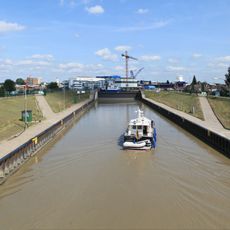
The Ledasperrwerk is a tidal barrier on the Leda near Leer, built as a sluice weir with five openings of 14 metres each. Its 10.5-metre lift gates sit between towers and are lowered to the sill; the middle towers rise 23.5 metres above the sill. The barrier stays open to preserve natural water and tide conditions and closes at low tide when water levels of 50 cm above mean high tide are forecast.
Planning for a barrier at the Leda's mouth began before World War II, stalled during the war and resumed afterwards; the waterway authority presented a design in 1949. Construction started in September 1950 in a dry bend of the Leda, and the river was then diverted through a roughly 1,000-metre cut. The barrier opened in July 1954 and withstood its first storm surge series five months later.
The barrier's name comes from the Leda river it dams at its mouth into the Ems. Its five lift gates stay open so the tide can pass, and they close only when water is forecast 50 cm above mean high tide. The design departed from older sluices that cut off tidal influence entirely, and after the 1953 North Sea flood similar storm-surge barriers were built on the Thames and Dutch river mouths.
The barrier stands where the Leda meets the Ems near Leer, and the old river bend survives as a cut-off arm below the structure. The gates normally stay open and close only when levels are forecast 50 cm above mean high tide, so a visit at ordinary tide shows an open weir rather than a closed one.
The Ledaschöpfwerk next to the barrier, built from January 2000 to December 2001, pumps 40 m³ per second — nearly 3.5 million m³ a day, slightly more than the entire capacity of the Leer storage polder. It keeps the Leda-Jümme area dry during long barrier closures and can also feed water into the Ems reservoir during ship transfers.
The community of curious travelers
AroundUs brings together thousands of curated places, local tips, and hidden gems, enriched daily by 93,625 contributors worldwide.