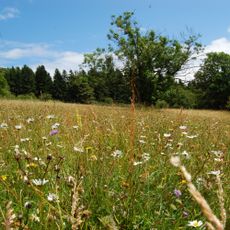
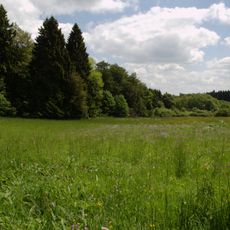
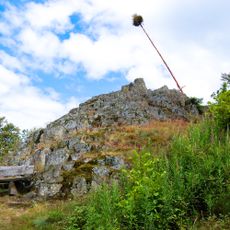
Taufstein, Volcanic summit in Vogelsberg Mountains, Germany
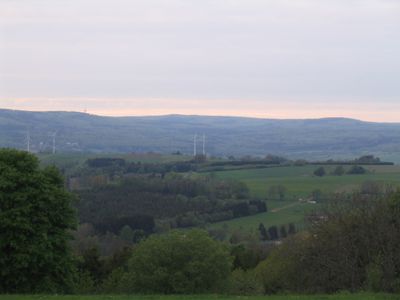
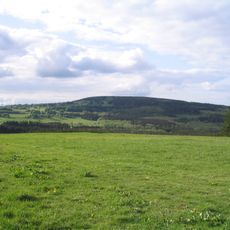
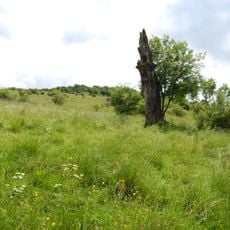
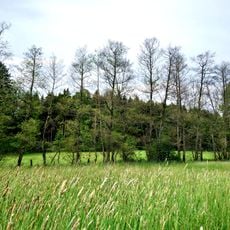
Taufstein is a volcanic mountain peak in the Vogelsberg range and reaches 773 meters as the highest point of this chain. The terrain is marked by volcanic rock formations and offers hiking paths accessible from different directions.
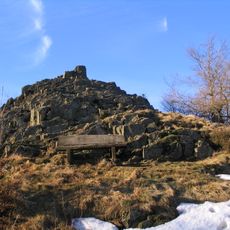
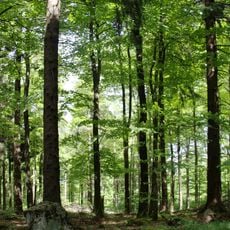
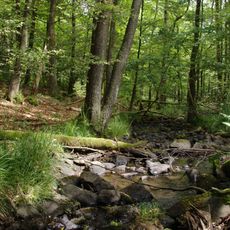
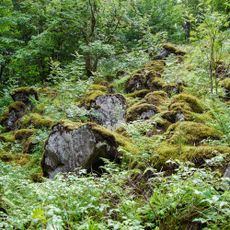
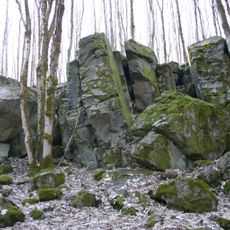
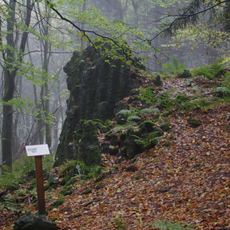
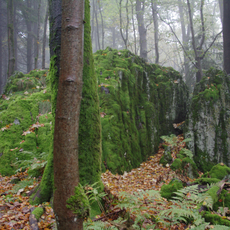
The summit is built from stacked basanite lava sheets, a silica-poor volcanic rock whose original cones were removed by erosion. During the Pleistocene, frost weathering on the north and west slopes produced block fields, now wooded. In 2013 the German Volcanological Society named the Taufstein a Geotope of the Year.
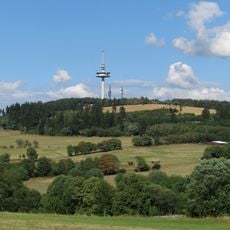
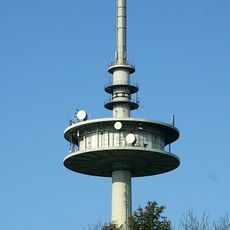
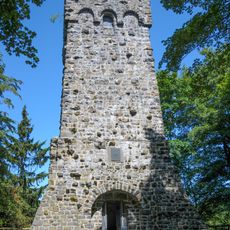
The 22-metre Bismarck Tower on the summit was built between 1907 and 1910 to a 1906 design by architect Ludwig Hofmann, after the Vogelsberg Heights Club's Lauterbach branch donated 3,000 marks in 1900 for a stone lookout tower. A plaque inside recalls Hugo Buderus, who chaired the building committee and helped fund it. The tower appears in the coat of arms granted in 1952 to the former Büdingen district, whose highest point was the Taufstein.
The summit lies 2.5 km northeast of Breungeshain, a district of Schotten, with the Hoherodskopf 1 km to the southwest. The 22 m Bismarck Tower on top has been closed since 2020 because of damage to its masonry and intermediate ceilings, and no renovation schedule exists. Its viewing platform is reached by 101 steps; the view is open to the west, north and east, while red beeches block it to the south.
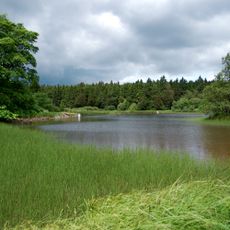
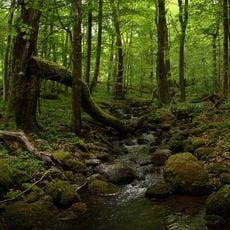
The summit marks the Rhine-Weser watershed: the Nidda rises from the Breungeshainer Heide moor on the north flank and drains to the Rhine, while the Altefeld springs east of the summit and reaches the Weser. The 7.31-hectare Blockfelder am Taufstein reserve, designated in 1973, protects basalt block fields on the north slope.
The community of curious travelers
AroundUs brings together thousands of curated places, local tips, and hidden gems, enriched daily by 93,847 contributors worldwide.