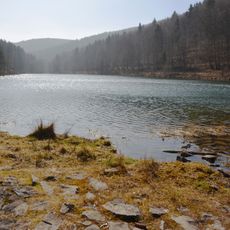
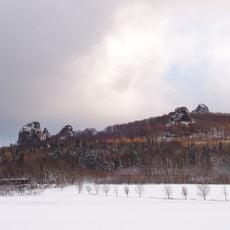
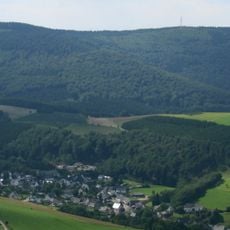
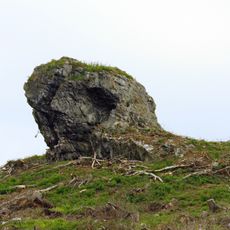
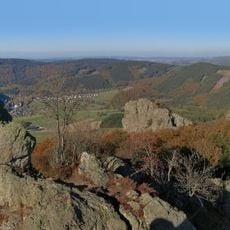
Bruchhauser Steine, Rock formation in Sauerland, Germany.
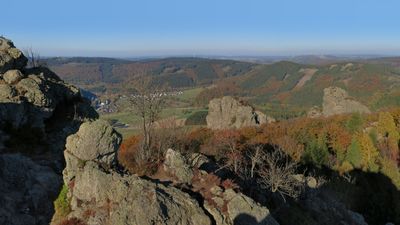
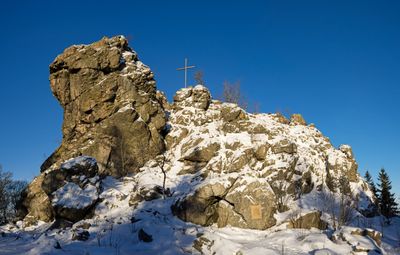
Bruchhauser Steine is a group of four porphyry crags on the Istenberg: Bornstein (92 m high), Ravenstein (72 m), Goldstein (60 m) and Feldstein (45 m). The Feldstein, topped by a 9 m wooden cross, is the only one that may be climbed, via the Thomas-Neiss-Steige. The rocks rise from soft Devonian slate that eroded away, leaving these volcanic remnants.
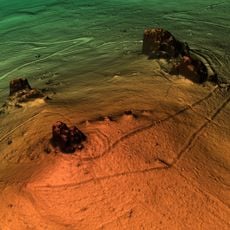
Between the four main rocks lay the Wallburg Bruchhauser Steine, a ramparted hillfort enclosing them; postholes of former wooden palisades were found in the surviving earthworks. Finds date the 8 to at least 11 hectare site to the early and middle Iron Age, 6th/5th to 3rd century BC, with a Neolithic axe as the oldest object; it was visited again in the early and high Middle Ages. Its function remains unclear, with use as a prehistoric refuge or cult site discussed.
The name Bornstein comes from Middle Low German borne, a spring, after a natural water pool on its summit; Ravenstein probably derives from Rabenstein, stone of the ravens. The four rocks are linked by paths named Wald- und Forstpfad, Archäologischer Pfad and Geologischer Pfad, which join into a circular walk. The archaeoastronomer Burkard Steinrücken suggests the rocks were used for calendar sightings of the solstices and moon.
A marked hiking trail of about 3 kilometers runs from an information center near the parking area through the site with some elevation gain. Sturdy footwear is recommended due to the rocky terrain and uneven surfaces along the path.
The Bornstein, the tallest of the four rocks at about 92 m, is a favoured breeding site of peregrine falcons; climbing all rocks has been forbidden since 1989 to protect nature. Only the Feldstein may be partly climbed, on the secured Thomas-Neiss-Steige.
The community of curious travelers
AroundUs brings together thousands of curated places, local tips, and hidden gems, enriched daily by 92,619 contributors worldwide.