Bunker Töpferweg, architectural structure
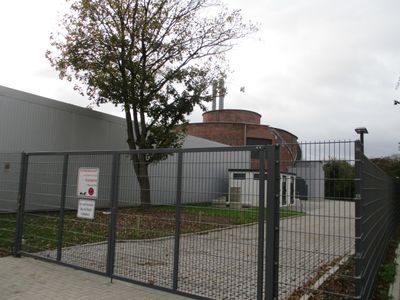
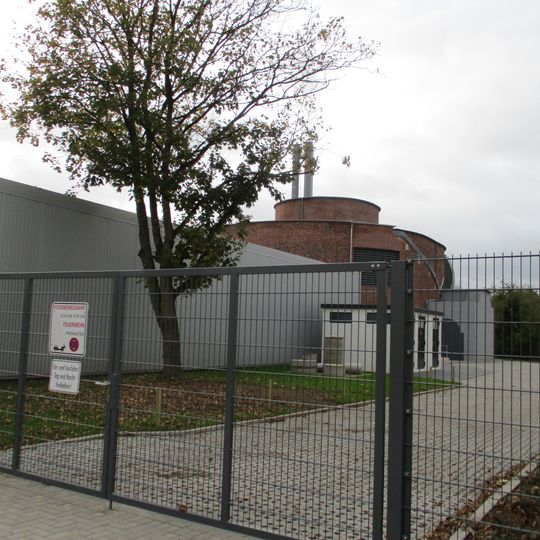
The Bunker Töpferweg is a former air-raid shelter in Lübeck-St. Lorenz, near the Drägerwerk. It is the only round bunker among Lübeck's 20 tower and high-rise bunkers, with four storeys reached by external staircases and a staggered top floor. Its usable area is 880 m².
Built in 1941, the round bunker was provisionally released in 1942 with 880 m² of usable floor space and about 900 shelter places; family cells were added later. After the war, demolition by blasting was demanded but never carried out. It was restored with 778 shelter places, served again as a civil-defence shelter from 1989, and was placed under monument protection in 2014.
Locals call the round bunker "Engelsburg", recalling Castel Sant'Angelo in Rome. Other Lübeck bunkers took the names of former local buildings, such as the Mühlentorbunker after the old Mühlentor gate or the Blauer Turm after the former Blue Tower; the Roman reference is the exception. Since 2014 the building has been a listed monument.
The round bunker stands free near the Drägerwerk in Lübeck-St. Lorenz, with its four storeys reached by outdoor staircases rather than an internal core. Since 2014 it has been a listed monument, and the Stadtwerke Lübeck now run a combined heat and power unit inside, so the interior is not open as a shelter museum. View it from the street as an architectural document of 1941 air-raid construction.
The Töpferweg bunker is the only one of Lübeck's 20 tower and high bunkers built as a free-standing round structure. Its four storeys, the top one a set-back attic storey, are reached by external staircases. Since the war the building has housed a combined heat and power plant run by Stadtwerke Lübeck.
The community of curious travelers
AroundUs brings together thousands of curated places, local tips, and hidden gems, enriched daily by 92,894 contributors worldwide.