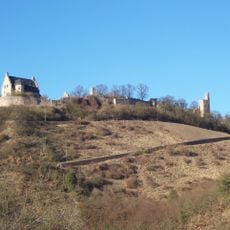
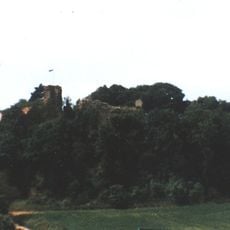
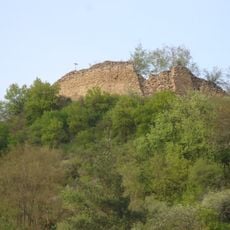
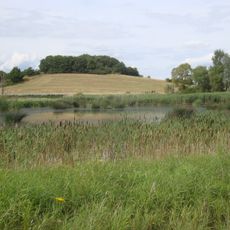
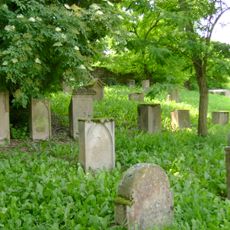
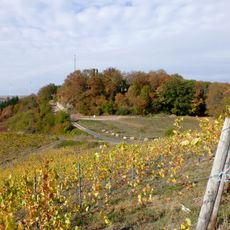
Burg Löwenstein, Medieval castle ruins in Niedermoschel, Germany.
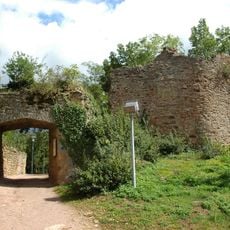
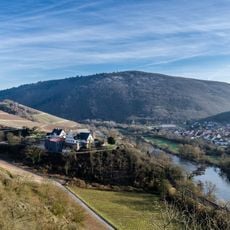
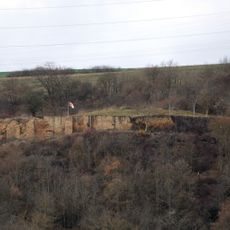
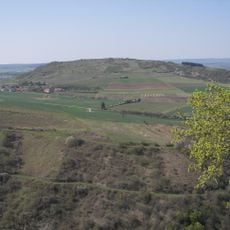
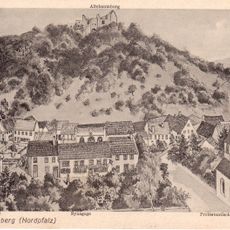
Burg Löwenstein, also called Lewenstein, is the ruin of a medieval hilltop castle at 210 m above sea level near Niedermoschel in the Donnersbergkreis. Only remains of the Palas (residential tower) survive; the private site is used as cattle pasture.
The castle was probably built by the Lewenstein family, whose first documented member, Emmerich von Lewenstein, appears in 1227. On 20 January 1275 Emmerich and Wolfram von Löwenstein enfeoffed the castle to Count Heinrich von Veldenz for an annual payment of eight pounds. It was damaged in 1525 during the German Peasants' War and finally destroyed in 1689 by French troops in the Palatine War of Succession.
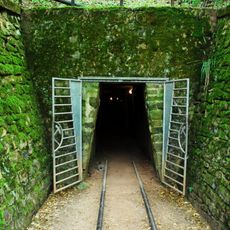
The name Löwenstein means "lion stone", but the sources do not explain its origin; the family is first documented with Emmerich von Lewenstein in 1227. Legend credits the Lewensteiner with the art of sensing metal, which links the castle to the silver mine at Niedermoschel, for which it may have served as protection.
You can reach the ruins by following Breitenweg Street through Niedermoschel where it extends toward the site. The main remains sit on the hilltop plateau, while other building fragments are scattered down the slope.
Legend held that the Lewenstein family could sense metal in the ground, which links the castle to the silver mine at Niedermoschel, where it may have served as protection. The first documented member of the family was Emmerich von Lewenstein in 1227.
The community of curious travelers
AroundUs brings together thousands of curated places, local tips, and hidden gems, enriched daily by 94,514 contributors worldwide.