Schmittenstollen, Former mercury mine and mining museum in Niederhausen, Germany.
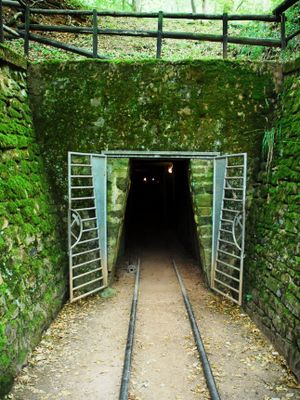
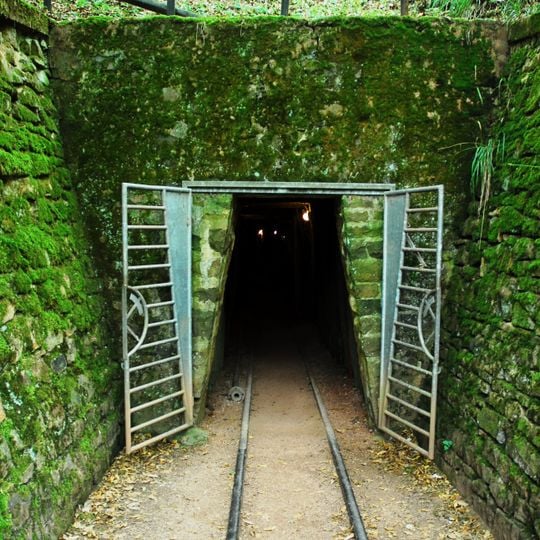
Schmittenstollen is a former mercury mine on the 420 m Lemberg near Oberhausen an der Nahe, in the Niederhausen district. Its complex of five gallery systems totals about 15 km, with a 60 m shaft linking them; 700 m of tunnel are open to guided visitors. Deep-red cinnabar is still visible in places on the rock walls.
The mine was first documented in 1438, when Count Palatine Stephan granted it to Frankfurt citizens. Three extraction periods followed: the 15th to 17th centuries, the 18th to early 19th centuries, and the 1930s. Ore was hauled by cable car to the valley and by truck to the Obermoschel mercury works. Mining stopped on 15 May 1939, and the last period ended in 1942 with safety works that sealed the adit. Volunteers cleared the entrance in 1976, and the mine opened to visitors in 1981.
The tunnels display tools and extraction methods used here across centuries, shaping how visitors understand the craft today. This site conveys how people worked underground in the region and what role this labor held in their lives.
The public section runs about 700 metres and is visited with a guide; the temperature stays at a constant 8°C, so bring a jacket and sturdy shoes. The tunnels are low and narrow, which matters for visitors with limited mobility or claustrophobia. In winter the galleries shelter bats.
The mine lies beneath the 420 m Lemberg, and its galleries stay at a constant 8°C, so bats use them as a winter roost. A 60 m shaft, the Maschinenschacht, linked the Schmittenstollen with the Karlsglückstollen, through which the ore was brought to the surface.
The community of curious travelers
AroundUs brings together thousands of curated places, local tips, and hidden gems, enriched daily by 93,621 contributors worldwide.