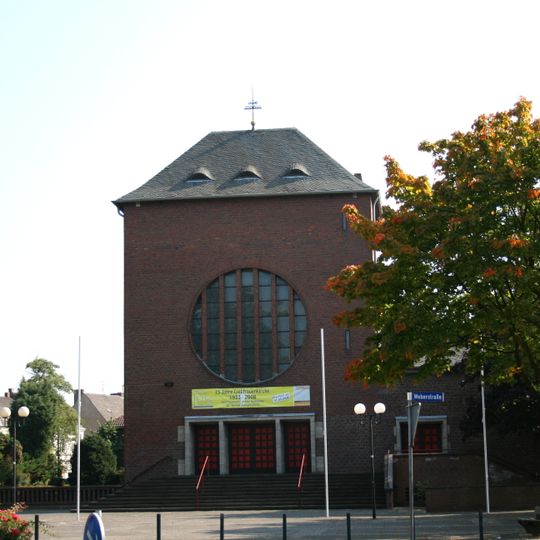
Liebfrauenkirche, Catholic church in Goch, Germany
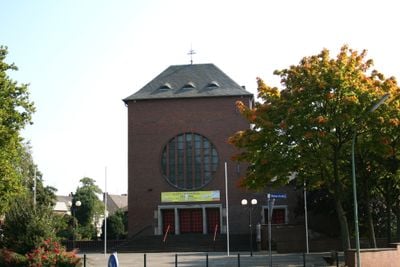
Liebfrauenkirche is a brick church in Goch with a cross-shaped plan oriented toward an east-facing altar in traditional religious arrangement. The building displays clear architectural features that fit within the construction traditions of the Lower Rhine region.
In 1927 pastor Brimmers declared the need for a second church as Goch's congregation grew; the church council approved the build in 1932, the first sod was cut on 22 May 1932 and the church was consecrated on 30 April 1933. From 1940 it served as a school while Goch's schools housed soldiers, and in January 1945 the Waffen-SS used it as an ammunition store. German paratroopers blew it up during their retreat, collapsing the tower; after the war services resumed in the cellar in August 1945. Bishop Felix Genn profaned the church on 22 November 2009 against public protest.
The name Liebfrauen refers to Mary, the Mother of God. From 1940, state regulations banned Corpus Christi, parish and Kevelaer processions, so believers walked to Kevelaer in small groups, and in 1944 a Corpus Christi procession was held on the church grounds. Since deconsecration in 2009, the building has occasionally hosted musical performances.
The building offers excellent acoustics that make it well-suited for events such as musical performances. Visitors should explore the architectural design and space layout to appreciate the interior qualities.
The church was deconsecrated on 22 November 2009, the feast of Christ the King, despite public protests by parishioners. Its organ, built in 1993 with 1,296 pipes and 20 stops across two manuals and pedal, was sold to Herten-Langenbochum, and some pews were placed in the Marienschiff of St. Maria Magdalena. A 2009 appraisal valued the building and grounds at about €800,000.
The community of curious travelers
AroundUs brings together thousands of curated places, local tips, and hidden gems, enriched daily by 94,638 contributors worldwide.