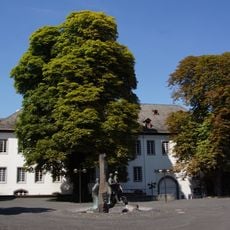
Schloss Neuwied, Cultural heritage château in Rhineland-Palatinate, Germany.
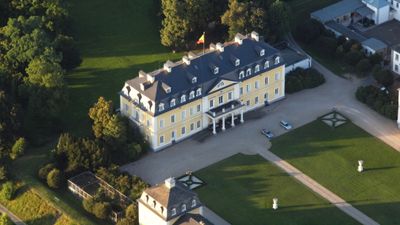
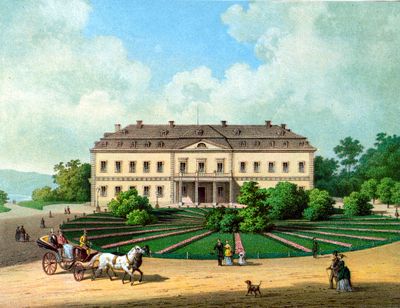
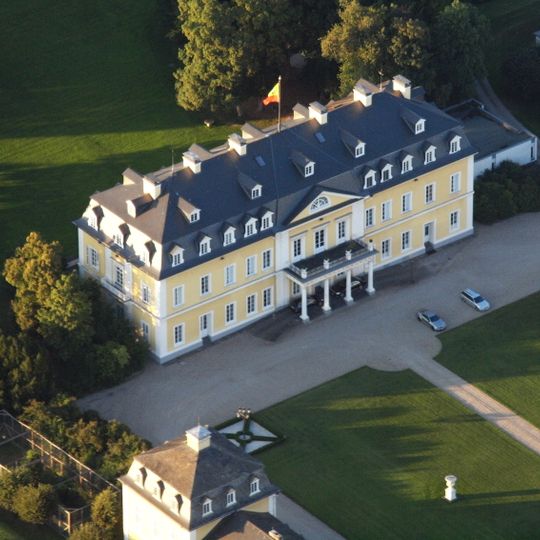
Schloss Neuwied is an open three-winged baroque complex facing the town, built from about 1706 to plans by Julius Ludwig Rothweil and completed in 1748–1756 under Karl Behaghel von Adlerskron. The two-storey main building has a mansard roof, a gabled three-axis central risalit, corner quoins and a main balcony on four Doric columns. The detached side wings each have a one-storey seven-axis centre flanked by two-storey corner pavilions; an iron grille of 1887 closes the cour d'honneur, where two cannons stand before the entrance.
Count Friedrich III zu Wied moved his residence from Burg Altwied and began building in 1648, first at Friedrichstein and a small fortress called Neuenwied at Langendorf. French troops burned that first structure in 1694 during the War of the Palatine Succession. The present palace was begun around 1706 to plans by Julius Ludwig Rothweil and completed in 1748–1756 under Karl Behaghel von Adlerskron.
The name Neuwied comes from the "Neuenwied" fortress Count Friedrich III built at Langendorf, and the town's 1653 charter reused a 1357 privilege from Nordhofen. The side wings once held the kitchen, laundry, wine press and stables; the lions and coat of arms above the gate date from the mid-18th century.
The complex is an open three-wing layout facing the town, with the corps de logis set back behind a courtyard closed to the south by an 1887 iron grille. The gate is flanked by two square guardhouses built in 1719–1720, and two historic cannons stand in front of the entrance. The grounds lie between the castle and the mouth of the Wied, south of the Rhine bank.
The two cannons standing before the entrance are historical pieces, and the wrought-iron lamps on the castle were made in the early 1980s by the Neuwied artist Klaus Rudolf Werhand, commissioned by Friedrich Wilhelm zu Wied.
The community of curious travelers
AroundUs brings together thousands of curated places, local tips, and hidden gems, enriched daily by 93,667 contributors worldwide.