Elbebrücke Schönebeck, Road bridge in Schönebeck, Germany
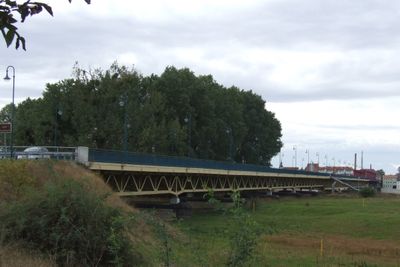
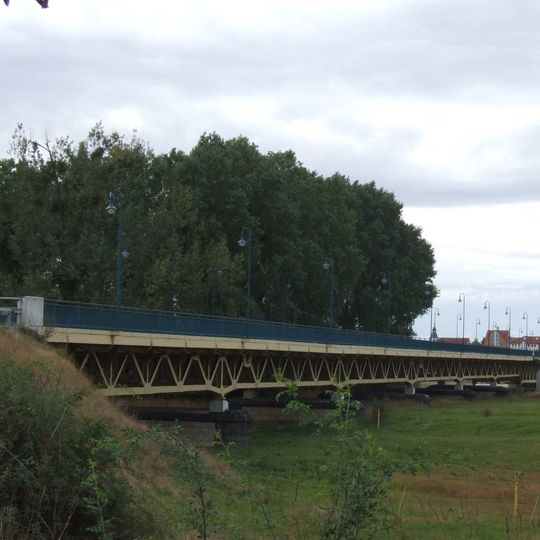
The Elbebrücke Schönebeck is a 585 m road bridge over the Elbe at kilometre 311.8, linking the town centre with Grünewalde. Its eastern approach, 425.6 m long, is a riveted steel truss with posts and a deck on top; the navigation span is a tied-arch truss.
First plans for a fixed Elbe crossing date from 1878; a memorandum to the Prussian government followed twenty years later and the design competition in 1903. The steel bridge, designed by Berlin architect Bruno Möhring and built by Dortmunder Stahlbau Aug. Klönne for 1,236,735 Mark, opened on 30 November 1912. Approval required annexing Grünewalde and Elbenau on 1 April 1913. German units blew up the river arch at the end of April 1945; the rebuilt span reopened on 20 May 1952 as the Ernst-Thälmann-Brücke.
The bridge is a protected monument; its steelwork was designed by Berlin architect Bruno Möhring in Jugendstil forms, and the river span was rebuilt in 1952 after German troops blew it up in April 1945. The name Ernst-Thälmann-Brücke dates from that reopening, performed by Rosa Thälmann, widow of Ernst Thälmann.
The bridge carries two traffic lanes plus combined foot and cycle paths on both sides, linking the centre of Schönebeck with Grünewalde. Since 2017 a 3.5-tonne weight limit has applied, buses excepted. Ships pass under with as little as 5.47 m clearance at high water, among the lowest spans over the Elbe.
The 1952 replacement span over the navigation channel is only 7.4 m deep and sits on a new pier, giving spans of 72.6 m and 60.9 m. Its clearance of 5.47 m at a gauge of 5.70 m makes it one of the lowest bridges over the Elbe.
The community of curious travelers
AroundUs brings together thousands of curated places, local tips, and hidden gems, enriched daily by 93,896 contributors worldwide.