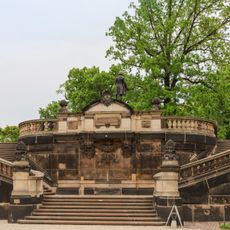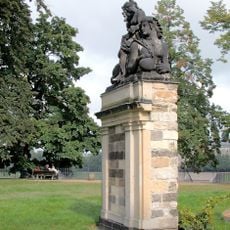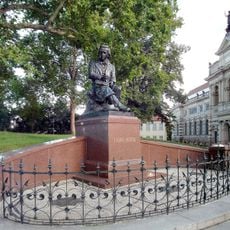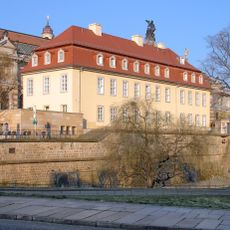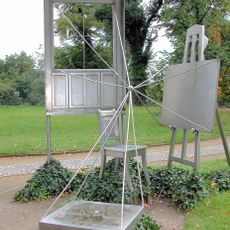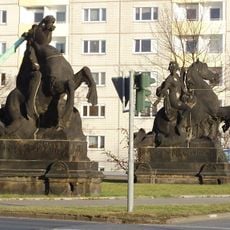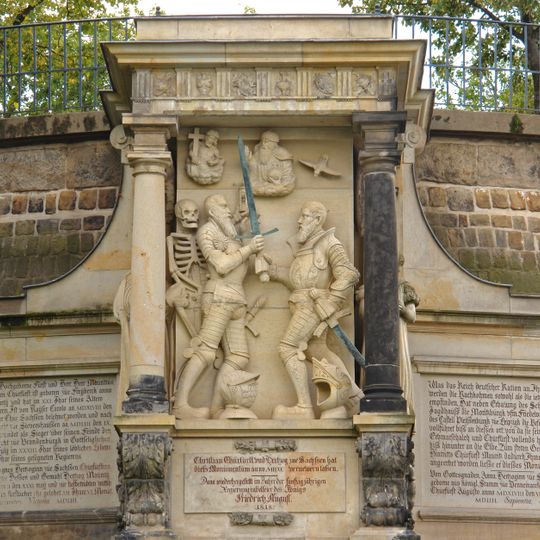
Moritzmonument, Dresden, Heritage monument at Terrassenufer, Dresden, Germany.
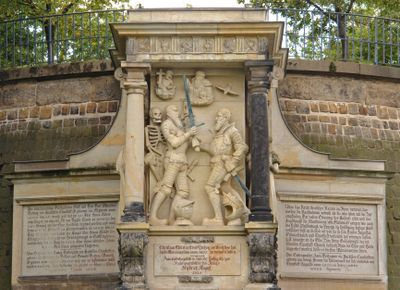
The Moritzmonument in Dresden is a sandstone work on the Jungfernbastei wall at Bruehl's Terrace, roughly 6 meters tall and 3 meters wide. The reliefs show figurative scenes with detailed depictions of people and symbols carved into the wall surface.
Hans Walther carved the sandstone monument in 1555, the first memorial raised to a Wettin ruler. It marks the fortification works at the time of Elector Moritz's death: mortally wounded at the Battle of Sievershausen in 1553, he left no heirs, so the electoral dignity passed to his younger brother August, shown receiving the Saxon electoral sword. Restored and moved in 1818 and 1871, it reached its present site in 1895.
The side panels carry long inscriptions honouring Elector Moritz, and the two wives appear with their coats of arms: Agnes of Hesse in widow's dress, Anna of Denmark in fashionable court attire. A 1591 drawing by court painter Zacharias Wehme shows the monument once gleaming with gold and colour, for a planned enlargement that was never built.
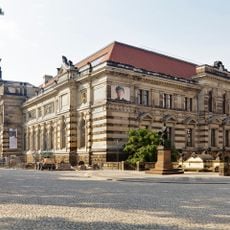
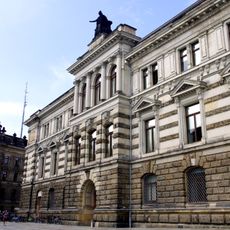
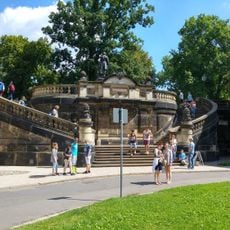
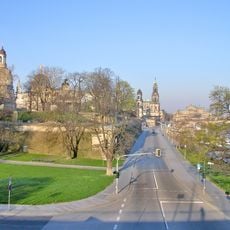
The monument stands at the northeast corner of the Dresden fortifications, at the eastern end of Brühl's Terrace where Terrassenufer meets Hasenberg (Augustusallee). The original was moved to the Kurfürstensaal of Dresden's Residenzschloss in 2017 after being recovered from the Festung Dresden museum following the 2013 Elbe flood; the outdoor monument is a copy.
The two women beside the electors are their wives, not allegories: Agnes of Hesse, Moritz's widow, wears mourning dress, while Anna of Denmark, August's wife, wears fashionable court clothing. Each appears with her coat of arms. A 1591 drawing by court painter Zacharias Wehme shows the monument once coloured and gilded, in a planned enlargement that was never built.
The community of curious travelers
AroundUs brings together thousands of curated places, local tips, and hidden gems, enriched daily by 92,892 contributors worldwide.