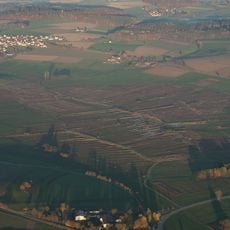
Wasserburg Buchau, Late Bronze Age archaeological site near Lake Federsee, Germany
Wasserburg Buchau is a Bronze Age settlement near Lake Federsee with wooden buildings surrounded by three protective palisade rings. The site covered an area of about 118 by 151 meters and held 38 small houses initially, then nine larger structures in a second building phase.
The settlement arose around 1100 BCE and was protected on the east by a triple palisade ring enclosing an area of 118 by 151 metres. Two building phases were identified: an older village of 38 small houses measuring 5 by 5 metres, and a younger settlement of nine three-winged complexes of about 100 square metres each. The younger settlement was destroyed by a major fire around 800 BCE.
The name Wasserburg, "water castle", comes from the palisade rings that once enclosed the settlement. Archaeobotanical work on the waterlogged sediments has identified about 20,000 plant remains; spelt, barley and millet formed the basis of bread and porridge, alongside opium poppy seeds, berries and leaf vegetables. The finds are held by the Landesmuseum Württemberg in Stuttgart and the Federseemuseum in Bad Buchau.
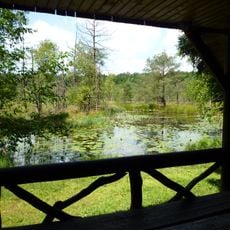
The excavation site itself is not directly accessible today, but artifacts and findings are well presented at the Federsee Museum in Bad Buchau. The museum is easy to visit and provides a clear introduction to the archaeological discoveries from this ancient settlement.
Archaeologists found six human skulls between 1920 and 1938, suggesting specific burial rituals practiced here. These discoveries raise questions about the spiritual beliefs and social customs of this ancient community.
The community of curious travelers
AroundUs brings together thousands of curated places, local tips, and hidden gems, enriched daily by 94,143 contributors worldwide.