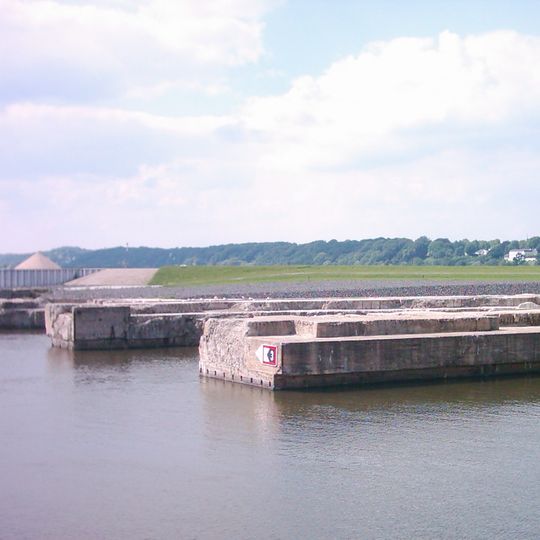
U-Boot-Bunker Finkenwerder, World War II submarine bunker in Finkenwerder, Germany.
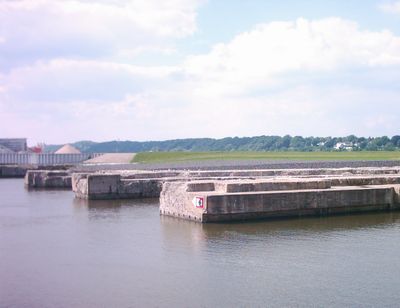
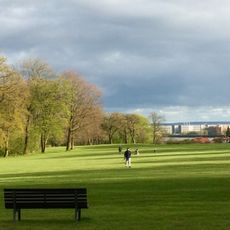
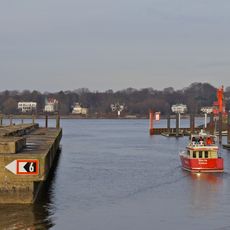
Fink II was a U-boat bunker of reinforced concrete built 1941–1944 at the Rüschkanal on Finkenwerder. It measured 151 m by 153 m, with a ceiling up to 3.6 m thick, and used 130,000 m³ of steel-reinforced concrete weighing 263,000 tonnes. After its demolition in 1945, the remains were buried; today black gravel outlines the footprint in Rüschpark, and a white sign with a red border and black arrow marks the site.
Planned in 1940, the bunker was built from March 1941 on the Deutsche Werft grounds; two wet boxes were ordered first, two more in summer 1941, and a fifth in 1942, so work ended only in 1944. The British blew it up on 17 October 1945; the ruin was later filled in and covered by the Rüschpark in 1996. The memorial opened on 26 August 2006.
The memorial, opened on 26 August 2006, was designed by Hamburg architects Anja Bremer and Beate Kirsch after a 2004 urban planning competition held by the Airbus runway construction company. Black gravel stones trace the bunker's footprint, and information boards recount that from 1941 forced labourers, prisoners of war and concentration camp inmates were increasingly used for the work.
The site is partially walkable and shows the excavated outlines of the bunker structure. Wear comfortable shoes as the ground can be uneven, and the gravel markings only outline where the structure once existed.
The memorial opened on 26 August 2006, after a 2004 competition won by Hamburg architects Anja Bremer and Beate Kirsch. Black gravel marks the footprint of the bunker, which was completely buried in the 1980s and raised into the Rüschpark viewing hill in 1996.
The community of curious travelers
AroundUs brings together thousands of curated places, local tips, and hidden gems, enriched daily by 92,851 contributors worldwide.