Fulbert-Stollen, Medieval water drainage gallery near Laacher See, Rhineland-Palatinate, Germany
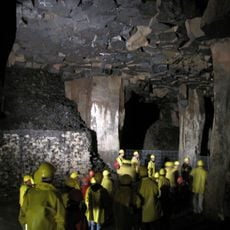
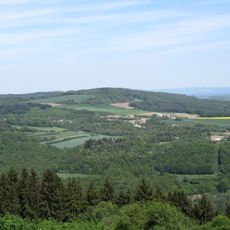
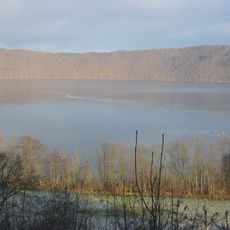
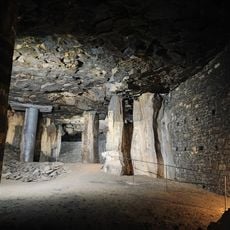
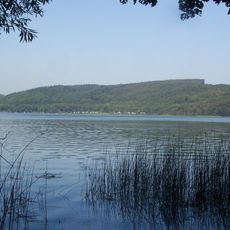
The Fulbert-Stollen is a medieval water drainage gallery in the Eifel region of Rhineland-Palatinate, cut through volcanic rock beneath the Laacher See area. The passage runs for about 880 meters and carries water from the lake toward a neighboring pond.
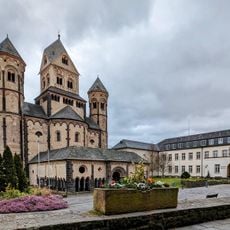
Klaus Grewe links the tunnel to a drought proven by dendrochronology from 1164 onward and named it after Abbot Fulbert of Laach (1152–1177), who was building Maria Laach Abbey. The gallery was meant to protect the abbey from flooding. It silted up in the mid-13th century and was cleared again under Abbot Dietrich II of Lehmen, as surviving accounts show. Some newer sources date its origin to Roman times.
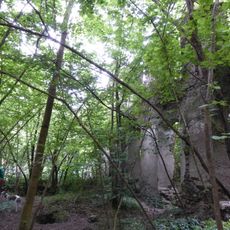
The name Fulbert-Stollen was given by the geodesist and archaeologist Klaus Grewe, who linked the tunnel to Abbot Fulbert of Laach (1152–1177) and a drought recorded from 1164. Nothing of the gallery is visible above ground today: its mouth lay south of the present Delius-Stollen opening, in the orchard, and small parts remain walkable through the Delius-Stollen.
Nothing of the Fulbert-Stollen is visible above ground today; its mouth lay south of the present Delius-Stollen opening, in the orchard. Small parts of the old gallery can still be walked through via the Delius-Stollen, which lies about 5 m lower and is 1060 m long.
The land gain came not from the Fulbert-Stollen but from the Delius-Stollen, driven between 1840 and 1845 by the Delius and von Ammon families, owners of the monastery estate and the lake. Lying about 5 m lower and 1060 m long, it dropped the lake by 48 hectares. Nothing of the Fulbert-Stollen remains above ground; its mouth lay south of today's Delius tunnel portal, in the orchard.
The community of curious travelers
AroundUs brings together thousands of curated places, local tips, and hidden gems, enriched daily by 92,881 contributors worldwide.