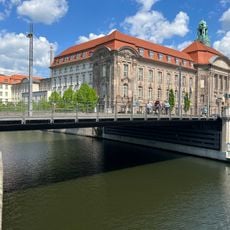
Humboldthafen Bridge, Railway bridge in Berlin-Mitte, Germany.
The Humboldthafen Bridge is a railway bridge composed of four independent concrete decks supported by steel arches spanning across the Humboldthafen waterway. The structure carries multiple railway tracks of the Berlin Stadtbahn system and uses a combination of cast steel joints and concrete elements in its construction.
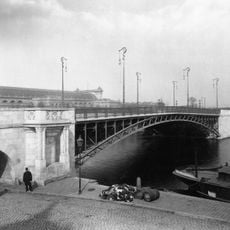
A first iron truss bridge was completed in 1880 and opened with the Berlin Stadtbahn in 1882; its girders were replaced in 1907–1909. After 1961 it crossed the sector border near the Wall. The present bridge was built from 1997 to 1999 to a design by Schlaich Bergermann und Partner with Gerkan, Marg und Partner; the old superstructures were dismantled from 2002 and removed by 2005.
The bridge's name comes from the Humboldthafen, the harbour basin it crosses east of Berlin Hauptbahnhof. Its steel half-arches rest on the concrete deck rather than meeting at the crown, a tied-arch form used here for the first time in modern railway bridge building. The design came from Schlaich Bergermann und Partner with architects Gerkan, Marg und Partner.
The bridge is located near Berlin Hauptbahnhof and is easily accessible by public transport. Visitors can view the structure from several vantage points around Humboldthafen and the surrounding areas.
The 2002 bridge was the first use of a tied-arch system anchored within the deck in modern railway bridge construction. Because the design was new, extensive component tests were run at the University of Karlsruhe before building. The half-arches do not meet at the crown; they rest on the prestressed concrete deck, joined by cast-steel nodes.
The community of curious travelers
AroundUs brings together thousands of curated places, local tips, and hidden gems, enriched daily by 93,748 contributors worldwide.