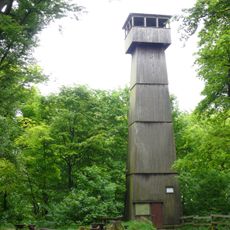
Hünstollen, Mountain summit in Lower Saxony, Germany.
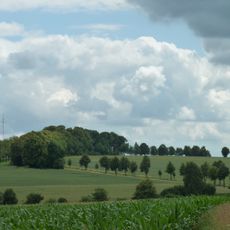
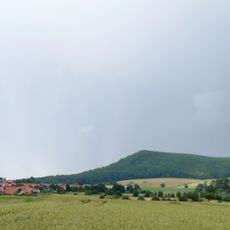
Hünstollen is a mountain summit in Lower Saxony with wide views across forested regions and rolling terrain. The peak sits within a landscape dominated by coniferous forests that cover the slopes around it.
The summit's slopes were fortified in two phases. Pottery and a few metal finds from small excavations in 1905 and 1959 date the older ramparts to the early pre-Roman Iron Age, around 500 BC. The innermost wall, built from the collapse of a mortared and dry-stone wall, belongs to the High Middle Ages, 9th to 12th century. The enclosure measured 220 m long and up to 185 m wide.
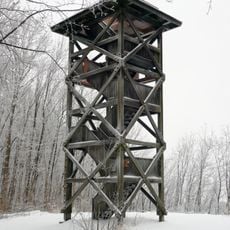
From the mid-19th century the Hünstollen served the Göttinger Stadtwald as a recreation area. In 1882 the Göttinger Verschönerungsverein built a shelter hut on the summit, and a year later innkeeper Finke of the Struthkrug added a second hut with Sunday drinks service. The tower, built in 1913 by carpenter Heinrich Kolle of Holzerode, was funded partly by innkeeper Heinrich Degenhardt, who paid for the foundation.
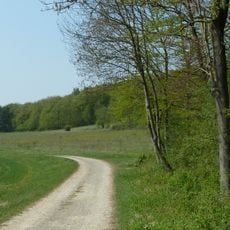
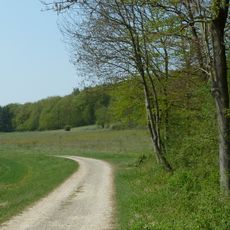
The summit is reached only on hiking trails, for example from Bösinghausen about 1.7 km to the southeast. A forest path cuts through all three rampart lines roughly at their midpoint, but the original entrance to the fortification lay in the south along the steep slope. The tower was reopened in June 2021 after repairs and new cladding in Siberian larch.
On the inner surface of the hillfort, several medieval lime kilns survive as low, flat mounds that visitors can still make out in the ground. Excavations in 1905 and 1959 uncovered pottery and a few metal finds showing the site was used in two phases, around 500 BC and again in the 9th to 12th centuries.
The community of curious travelers
AroundUs brings together thousands of curated places, local tips, and hidden gems, enriched daily by 94,574 contributors worldwide.