Gerhart-Hauptmann-Haus, Cultural and historical museum in Düsseldorf, Germany.
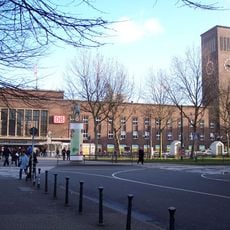
The Gerhart-Hauptmann-Haus is a five-storey concrete building at Bismarckstrasse 90 in Düsseldorf, designed by Walter Kroner and Bruno Lambart and built from 1960 to 1962. Its lower floors are fully glazed; above, the left third of the facade holds a carillon of 20 bells, installed in 1985 and crowned by a model of the roof of the Danzig Krantor. The other two thirds have two rows of square windows, behind which lies the Eichendorff-Saal.
The house was founded in 1963 to preserve and research the history of Germans from Eastern Europe. It emerged as a response to displacement and migration following World War II and continues to serve as an important archive for this period.
The house is named after Gerhart Hauptmann, a Silesian-born writer, not an Eastern European one. Its carillon of 20 bells, inaugurated in 1985, is framed by coats of arms of former German cultural regions such as East Prussia and Lower Silesia, with Düsseldorf's and the federal coat of arms in the lower row. It can play regional songs and the Deutschlandlied.
The building stands at Bismarckstraße 90, close to the main station, and its address is a frequent gathering point for demonstration marches heading into central Düsseldorf. The foundation keeps a large specialist library on the history of East-Central and Eastern Europe for research use. The carillon in the left third of the facade faces the street and can be heard from outside.
The foundation published the West-Ost-Journal quarterly from 1995 to 2022; since 2023 it has appeared twice a year with background reports and travel accounts. The carillon on the facade, installed in 1985, has 20 bells and can play the Deutschlandlied, regional songs or the Ostpreußenlied.
The community of curious travelers
AroundUs brings together thousands of curated places, local tips, and hidden gems, enriched daily by 93,764 contributors worldwide.