Tausendfüßler, Demolished elevated road in Düsseldorf, Germany
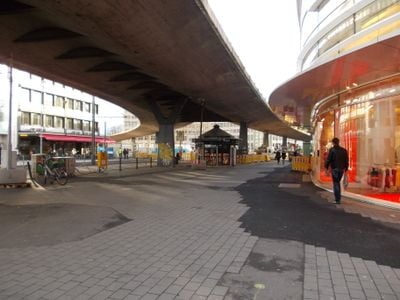
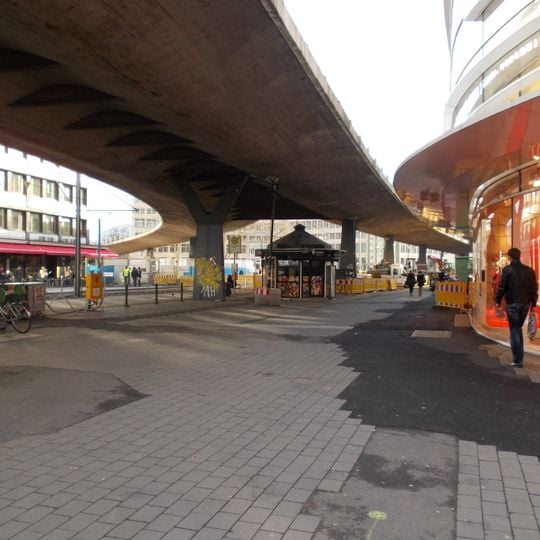
The Tausendfüßler was a 536-metre elevated road bridge in Düsseldorf, built from 1961 to 1962. Its prestressed concrete deck, only one metre thick, was carried by Y-shaped steel columns and appeared as a double wave in cross-section, with narrow white-painted edges. The main arm ran 391 metres from Hofgartenstraße to Berliner Allee; a 145-metre side arm branched toward Immermannstraße.
Planned as part of Düsseldorf's post-war reorganisation, the elevated road was built from 1961 to 1962 and opened as a link of Landesstraße 55. A 1961 demonstration by 10,000 people against the loss of part of the Hofgarten reduced the scale of the works. It was listed as a technical monument in December 1993, approved for demolition by minister Harry Voigtsberger on 11 June 2012, and removed by April 2013 for the Kö-Bogen project.
The structure held protected status as a technical monument from 1993 onward and formed an architectural ensemble with the Thyssen building and the Theater. This combination shaped how people experienced the city center's visual character for decades.
As an elevated structure, it was accessible only to vehicles traveling on a separate level above the street. Pedestrians could not use it, so walking routes through the city center remained separate from this traffic flow.
The nickname referred to the slender prestressed-concrete deck, just 1.0 metre deep, carried on Y-shaped steel columns and 5+5 standard supports. Architect Friedrich Tamms, the city's planning chief, also designed Düsseldorf's Rhine bridges. The structure was listed as a technical monument in December 1993, yet demolition was approved by state transport minister Harry Voigtsberger on 11 June 2012.
The community of curious travelers
AroundUs brings together thousands of curated places, local tips, and hidden gems, enriched daily by 93,641 contributors worldwide.