Golden Bridge, Footbridge in Stadtmitte, Düsseldorf, Germany
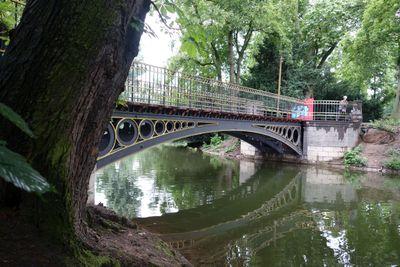
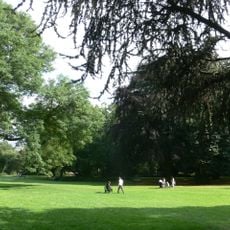
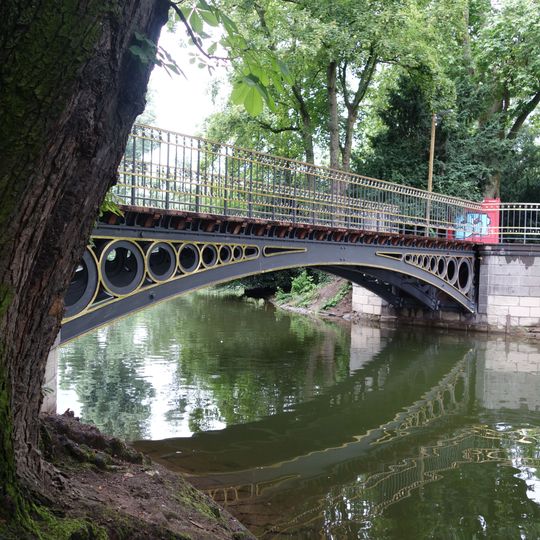
The Golden Bridge is a flat-decked pedestrian bridge in the Hofgarten, its two partially gilded steel beams resting on masonry abutments and carrying joists and wooden planks. Forged railings stand on the abutments and along the deck; the present railing dates from 1951. It links the two peninsulas between the ponds formed by the dammed Nördliche Düssel.
The first arched bridge here was built in 1809 to a design by Adolph von Vagedes, linking the two ponds of the New Hofgarten. Its railing was painted gold-bronze in 1820, which likely gave the bridge its name. In 1845 Anton Schnitzler replaced it with the present flat-decked bridge; the structure was overhauled after World War II and again in 2015/2016.
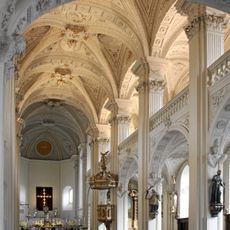
The name comes from the handrail painted in gold-bronze in 1820, on the arched bridge built in 1809. The crossing sits on a baroque sightline that once ran about 900 metres between Schloss Jägerhof and St. Andreas; looking east from the bridge, the Reitallee leads the eye to Schloss Jägerhof.
The bridge carries pedestrians and cyclists over the narrow point between the two Hofgarten ponds, linking the northern and southern peninsulas. Its deck is timber planking on steel beams, so it can be slick in wet or frosty weather. Renovation work kept it closed until June 2016, and bridge lanterns were fitted before mid-2019.
The bridge crosses a baroque sightline that once ran about 900 metres between Schloss Jägerhof and St. Andreas; Johann Petersen recorded the original bridge, garden and axis in two watercoloured lithographs in 1816. Looking east from the deck, the Reitallee of the Old Hofgarten leads the eye to Schloss Jägerhof.
The community of curious travelers
AroundUs brings together thousands of curated places, local tips, and hidden gems, enriched daily by 93,296 contributors worldwide.