Hängebrücke Weimar, Suspension footbridge in Weimar, Germany
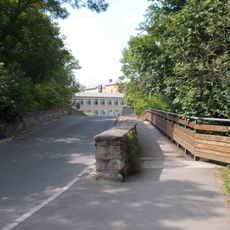
The Hängebrücke Weimar is an iron footbridge crossing the Ilm River and connecting both sides of a park. The structure measures roughly 15 meters long and uses eyebar cables as its main supporting elements.
A wooden bridge, probably used by raftsmen, first stood here; the stone-pillared structure dates from 1833. Its two limestone piers rest on wooden piles, and riveted steel eyebars carry the deck while also forming the railing. Flood damage in 2013 forced a temporary closure, and the restoration by Johann Philipp Jung and Oliver Hahn received the Deutscher Brückenbaupreis in 2018.
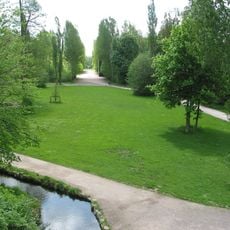
Locals call it the Schaukelbrücke, the "swing bridge", for the slight sway felt when crossing. The bridge links the Belvederer Allee with the eastern part of the Park an der Ilm, and the Ilm flows directly beneath it. Nearby, at Belvederer Allee 24, stands the long-established Stengel furniture workshop.
The bridge is about two metres wide and 14 metres long, so crossing takes only a moment; it links the Belvederer Allee near the Falkenburg with the eastern part of the Park an der Ilm. After flood damage in 2013 it was closed for a time and then repaired, work that received the Deutscher Brückenbaupreis in 2018. Look for the carved shell on the round tops of the limestone piers.
The bridge's stone piers are founded on wooden piles and topped with a carved shell in a round finial. Its designer was the Weimar building officer Karl Friedrich Christian Steiner. After flood damage in 2013 it was closed, then repaired; the restoration won the German Bridge Construction Prize in 2018.
The community of curious travelers
AroundUs brings together thousands of curated places, local tips, and hidden gems, enriched daily by 93,115 contributors worldwide.