Allerheiligenkapelle, Late Gothic chapel in Nuremberg, Germany
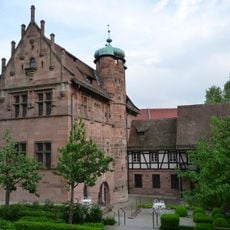
The Allerheiligenkapelle is a late Gothic hall church of reddish-brown sandstone, built as a short three-nave structure roofed by a net vault. Its left wall has three tall pointed-arch windows with dark tracery, and a small green spire sits on the roof where the two wings meet. A pointed-arch doorway reached by a few steps opens at the base of the right wing.
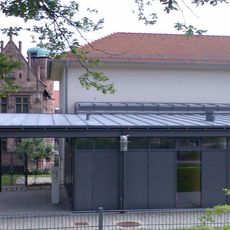
The Allerheiligenkapelle was built between 1501 and 1510 as the private chapel of the Landauer Twelve Brothers House, following plans by Nuremberg architect Hans Beheim the Elder. After the death of its founder, the merchant Matthäus Landauer, the chapel housed his burial place. In 1955/56 the Willstätter Gymnasium was built on its west side, replacing the Twelve Brothers House destroyed in the Second World War.
The original All Saints painting by Albrecht Dürer from 1511 decorated this chapel before its transfer to the Kunsthistorisches Museum in Vienna.
The chapel stands on Archivstraße in central Nuremberg, west of the Landauer Twelve Brothers House site, which was replaced in 1955/56 by the Willstätter-Gymnasium. Since 2006 the Old Catholic congregation has held its services here, so visits should be timed around worship. The entrance is the pointed-arch doorway at the base of the right wing, reached by a few steps.
The chapel's copy of Dürer's All Saints picture was painted by Helmut Weigand, a teacher at the Willstätter-Gymnasium, the school built in 1955/56 on the chapel's west side where the Twelve Brothers House stood until its wartime destruction. The original frame is kept in the Germanisches Nationalmuseum in Nuremberg.
The community of curious travelers
AroundUs brings together thousands of curated places, local tips, and hidden gems, enriched daily by 94,072 contributors worldwide.