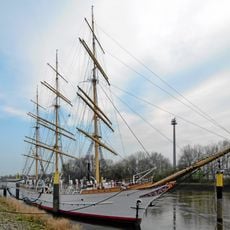
Grönland, Museum ship at German Shipping Museum in Mitte, Germany.
The Grönland is a sailing ship measuring about 26 meters in length, now displayed as an exhibit at the German Shipping Museum. The vessel has a sturdy wooden hull and shows how research ships were built in the 1800s.
Built in 1867 by Toleff Toleffsen at Skånevik in Norway as a sealing vessel of the Nordic Jagt type, the Grönland was bought in 1868 by Captain Carl Koldewey for the First German North Polar Expedition and renamed. It sailed from Bergen on 24 May 1868 and reached 81° 4' 30" N, then entered Bremerhaven for the first time on 10 October 1868. Deemed too small for the second expedition, it was sold back to Norway in 1871 and served as a coastal sailer, fishing boat and leisure craft until 1970, converted to motor power in 1917.
The name Grönland reflects the polar exploration that defined this vessel. Visitors can see today how a research ship of the 1800s was equipped and what role it played in Arctic discovery.
The Grönland lies directly in front of the Deutsches Auswandererhaus in Bremerhaven's Alten Hafen, the city's oldest harbour basin. Since spring 2020 it has been at a shipyard in Hvide Sande, Denmark, for work on its wooden hull, so it is not at its berth. A volunteer permanent crew otherwise looks after the ship.
The Grönland reached 81° 4′ 30″ N on 24 May 1868, then the northernmost point ever attained by ship and still the farthest north reached under sail without auxiliary power. Its bow was reinforced against pack ice, and the hull was rebuilt as a motor vessel in 1917.
The community of curious travelers
AroundUs brings together thousands of curated places, local tips, and hidden gems, enriched daily by 93,014 contributors worldwide.