German Emigration Center, Migration museum in Bremerhaven, Germany
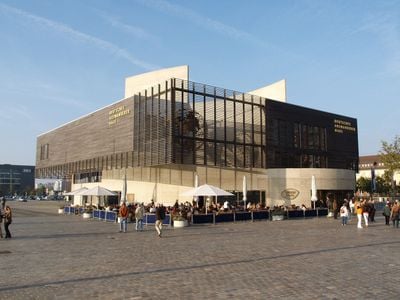
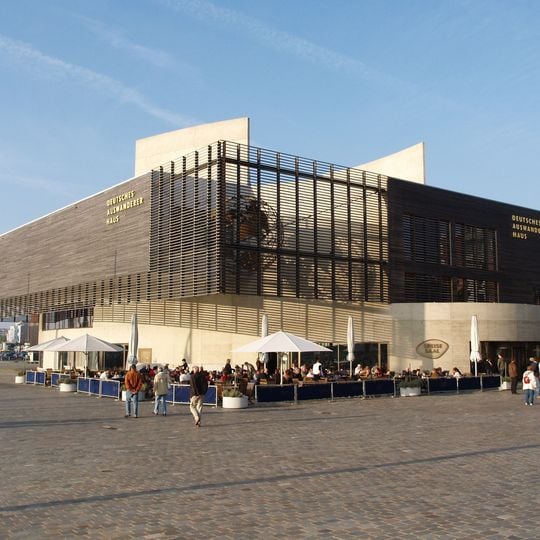
The German Emigration Center stands at Marie-Juchacz-Platz 1 on the Neuer Hafen, a 5,451-square-metre building designed by Hamburg firm Andreas Heller Architects & Designers. Its long facade combines a pale stone base with glass doors, horizontal dark wood-like slats above, and a projecting section of vertical metal louvres; "DEUTSCHES AUSWANDERERHAUS" is inscribed twice in capitals. The 2021 extension has portrait reliefs of immigrants to Bremerhaven set into its facade.
Citizens of Bremerhaven campaigned from the late 1970s for a museum on emigration, and the Deutsches Auswandererhaus opened on 8 August 2005 at the Neuer Hafen, a harbour opened in 1852. Between 1830 and 1874 Bremerhaven was the largest emigrant port in continental Europe. A 2012 extension added over 300 years of immigration to Germany, and six more rooms followed in 2021.
The name refers to the emigration harbour: between 1830 and 1874 Bremerhaven was the largest departure port in continental Europe. On the tour, visitors pass a reconstruction of the waiting hall opened in 1870 by the Norddeutscher Lloyd and board replicas of emigrant ships of the 1850s, 1880s and 1920s. The route ends in New York settings, among them a partial copy of the Old Town Bar and a deli run by emigrants from the island of Föhr.
At the entrance each visitor receives an electronic card with the story of a real person you can follow through the exhibition. The route leads chronologically through different areas and takes varying amounts of time depending on your interest.
In the research area visitors can search old passenger lists and ship documents for the names of their ancestors. Many people discover here for the first time concrete details about their family's crossing.
The community of curious travelers
AroundUs brings together thousands of curated places, local tips, and hidden gems, enriched daily by 93,678 contributors worldwide.