Teufelssteine, Neolithic passage grave in Osnabrück, Germany
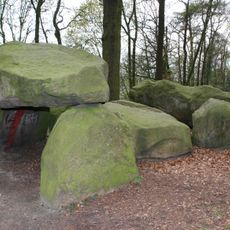
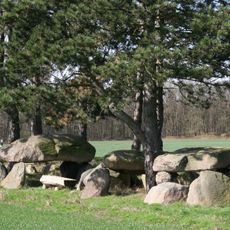
Teufelssteine is a Neolithic passage grave of the Emsländische Kammer type (Sprockhoff no. 914) in northern Voxtrup, Osnabrück. Its east-west chamber is about 12.9 metres long and two metres wide, formed by 14 upright support stones carrying six capstones; one of each is missing. The chamber sits within an oval enclosure of which roughly a dozen stones remain, and the entrance gap is visible on the southern long side between the third and fourth support stones.
The monument was built between 3500 and 2800 BCE by the Funnel Beaker culture, an early farming society in northern Europe. It demonstrates how these prehistoric communities buried their dead in stone chambers that likely served important ritual or social functions.
The monument is also called Teufelsbett, Düvelsteine or Lehzensteine, and the surrounding area was historically known as Teufelsheide. It lies on the Straße der Megalithkultur, a tourist route linking megalithic tombs in northwest Germany. Two further tombs, the Sundermannsteine and the Gretescher Steine, stand in the same Osnabrück district.
The grave site is located in a small wooded area surrounded by industrial buildings and remains accessible to visitors year-round at no cost. The open-air setting allows people to walk around the structure and observe its arrangement from different angles.
The oval enclosure around the chamber keeps only about a dozen stones; the chamber itself is 12.9 m long and about 2 m wide, with one of six capstones and one of fourteen supporting stones missing. The entrance gap is still visible in the middle of the southern long side, between the third and fourth supporting stones.
The community of curious travelers
AroundUs brings together thousands of curated places, local tips, and hidden gems, enriched daily by 94,637 contributors worldwide.