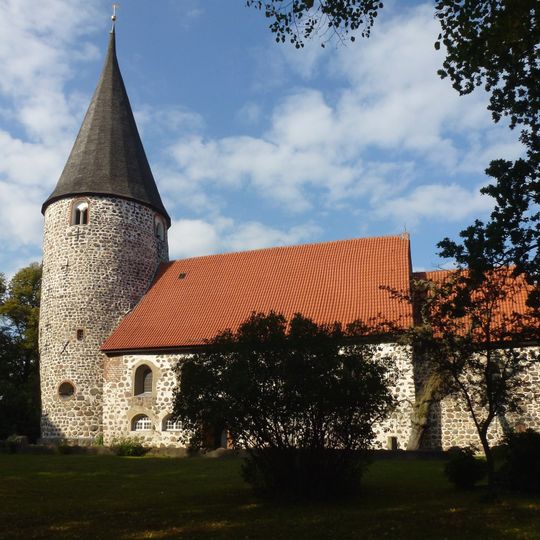
Vicelinkirche, Romanesque fieldstone church in Ratekau, Germany
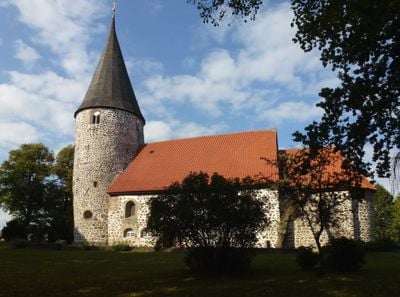
Vicelinkirche is a single-nave Romanesque fieldstone church with a choir and apse, built from fieldstones bound with gypsum mortar from the Segeberg limestone hill. Its 48-metre leaning round tower served as a defensive tower, and the nave has a wooden-shingled gable roof. A fieldstone sacristy was added on the north side in 1913.
Construction began in 1156, two years after Vicelin's death, on a site chosen by Count Adolf II and Bishop Gerold of Oldenburg, as Helmold of Bosau reports. The church was first documented in 1234/35 when the apse arch and vaults were renewed. Renovations followed in 1824, 1933 and 1956, and a fieldstone sacristy was added on the north side in 1913.
The church is also called Vicelinkirche after the missionary Vicelin, though construction began in 1156, two years after his death. Inside, a late-16th-century crucifix hangs in the apse arch, and the pulpit basket is the only piece still in use from the 1824 furnishings. A reconstructed baptismal angel from 1764 stands in a niche beside the passage from nave to choir.
The church stands in the centre of Ratekau, and the 48-metre leaning round tower is visible from afar as a landmark. The interior is heated by 15 geothermal probes, so it stays usable in winter. Look for the 1913 sacristy annex of field stones on the north side, added during the renovations of 1824, 1933 and 1956.
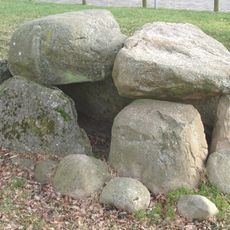
The walls were built from field stones found on the site and connected with gypsum mortar sourced from the limestone deposits of Segeberg mountain. This local building technique is characteristic of many early stone churches in the region.
The community of curious travelers
AroundUs brings together thousands of curated places, local tips, and hidden gems, enriched daily by 94,581 contributors worldwide.