Albanifriedhof, Cemetery and architectural monument in Göttingen, Germany
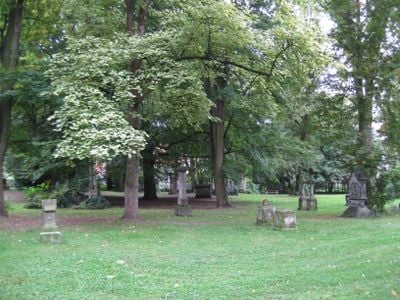
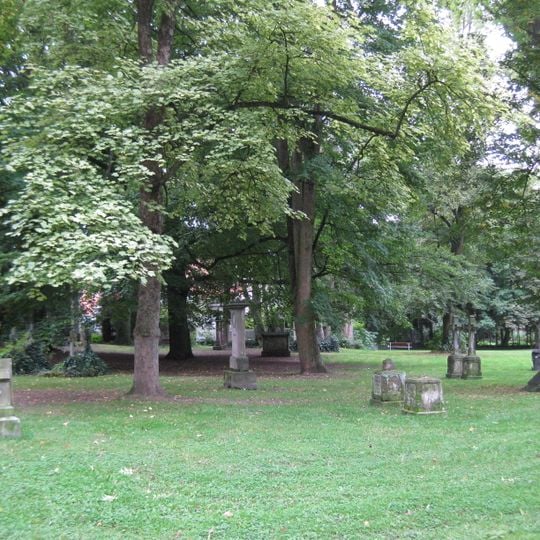
Albanifriedhof is a disused cemetery of about 12,600 m² on the southeastern edge of Göttingen's old town, just outside the former city wall and bordering Cheltenhampark to the north. Only thirty gravestones survive, the oldest dated 1816; among the low sandstone pedestals and stepped bases stands Carl Friedrich Gauss's enclosed neo-Gothic granite monument.
Established in 1783 beyond the city walls, the cemetery underwent five expansions, with the last one completed in 1963. After a new cemetery opened in 1975, it reached its current form and stopped accepting new burials outside existing family plots.
The cemetery is named after the adjacent St Albani Evangelical Lutheran Church. Since it closed for burials, it has served as a public park: on warm summer evenings people gather and barbecue among the graves, and the Schwänchenteich pond in the northwest is the last remnant of the old town moat.
The cemetery lies just outside the former city wall southeast of the old town, bordered to the north by Cheltenhampark; entrances are from Teichweg and Schildweg. It is no longer used for burials and now serves as a public park, so people walk, sit and barbecue between the graves on warm summer evenings. The Schwänchenteich, the last remnant of the old moat, lies to the northwest.
Only about thirty grave markers survive today, the oldest dated 1816, after bombing damage in the Second World War destroyed most graves and the surrounding wall. The Gauss monument, a fenced neo-Gothic granite tomb, was not erected until January 1859, following a design of 1856 by Hanover architect Heinrich Köhler, with the bronze medallion by sculptor Heinrich Hesemann.
The community of curious travelers
AroundUs brings together thousands of curated places, local tips, and hidden gems, enriched daily by 93,850 contributors worldwide.