Accouchierhaus Göttingen, Historical medical building in Göttingen, Germany
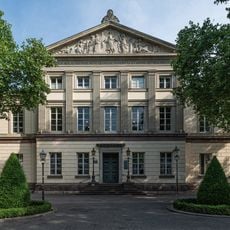
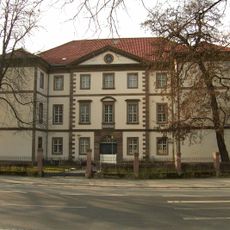
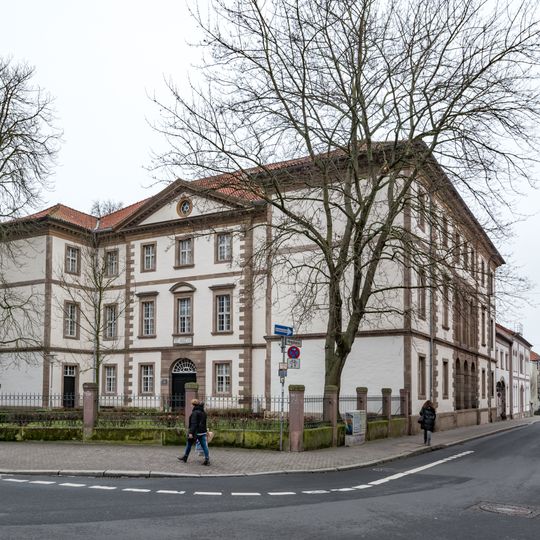
The Accouchierhaus Göttingen is a three-story baroque building at Kurze-Geismar-Straße 1, erected 1785–1791 to plans by university master builder Georg Heinrich Borheck, considered his main architectural work. Its white plastered facade has reddish-brown stone trim, a slightly projecting central section under a triangular pediment with a small star window, and a hipped red-tiled roof. A round-arched doorway with a fanlight sits at ground level, and a stone and metal fence runs along the paved sidewalk.
The Göttingen maternity institute was founded in 1751 by Albrecht von Haller, initially housed in a modest single-storey timber-framed building next to the St. Crucis chapel. The present building was erected in 1785–1791 to plans by university architect Georg Heinrich Borheck, considered his main architectural work. A memorial plaque above the main entrance commemorates Borheck and the Kassel obstetrician Georg Wilhelm Stein, dated 1784.
The name Accouchierhaus comes from the French accoucher, to give birth; the official title was Königliche Entbindungsanstalt an der Universität Göttingen, and Göttingen long used Accouchir-Hospital or Accouchiranstalt. The building now houses the university's musicology department, whose collection of over 1,000 musical instruments is used for research and teaching. A Göttingen memorial plaque above the main entrance honours the founders, gynaecologist Hofrat G. W. Stein and master builder Borheck, dated 1784.
The Accouchierhaus stands at Kurze-Geismar-Straße 1, opposite the St. Crucis hospital chapel, where the street meets the old town wall. The building is a university institute, not a public museum, so visits depend on the Musicology Department's arrangements. From the sidewalk, the white facade, the triangular pediment with its star window and the memorial plaque above the main entrance are visible.
The memorial plaque above the main entrance names two founders: the Kassel gynaecologist G. W. Stein and the university architect Borheck, dated 1784. Stein had advised on the new building after working on Kassel's maternity and foundling house. The plaque is easy to miss above the arched doorway.
The community of curious travelers
AroundUs brings together thousands of curated places, local tips, and hidden gems, enriched daily by 94,006 contributors worldwide.