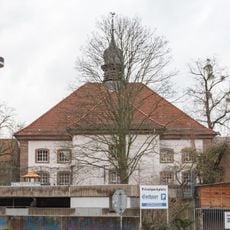
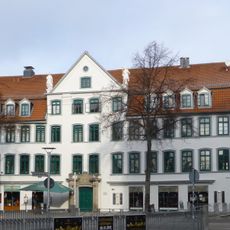
Auditorium of the Georg August University, University auditorium in Göttingen, Germany.
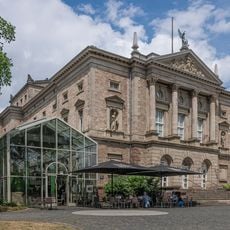
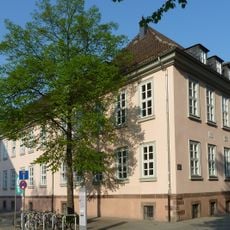
The Auditorium of the Georg August University is a neoclassical building on Wilhelmsplatz, completed in 1837. Its south facade has a projecting central section with a triangular pediment carved by Ernst von Bandel, showing allegories of theology, jurisprudence, philosophy and medicine around a genius of science. The T-shaped plan places the large festival hall in the rear wing.
The Aula was built between 1835 and 1837 and inaugurated in September 1837 for the university's first centenary. King William IV of Great Britain and Hanover funded it with an additional 3,000 pounds sterling in 1835. After his death, his brother Ernest Augustus opened the hall and the adjacent monument to William IV, renaming the New Market as Wilhelmsplatz.
The hall serves as the setting for university elections and academic ceremonies where the student body gathers regularly. Public concerts and lectures held here create spaces for students and city residents to come together and share in intellectual life.
The hall is conveniently located in central Göttingen and easily accessible on foot, with good public transport connections. Visitors to events can expect ample seating and good sightlines, though it is worth checking in advance whether reservations are required for a particular event.
The triangular pediment of the main facade carries allegorical stone figures by sculptor Ernst von Bandel, who also made the statue of King William IV on the square. At the centre stands the Genius of Science; Theology with cross and Bible, Jurisprudence with scales and sword, Philosophy with globe and harp, and Medicine with the torch of life flank him.
The community of curious travelers
AroundUs brings together thousands of curated places, local tips, and hidden gems, enriched daily by 93,137 contributors worldwide.