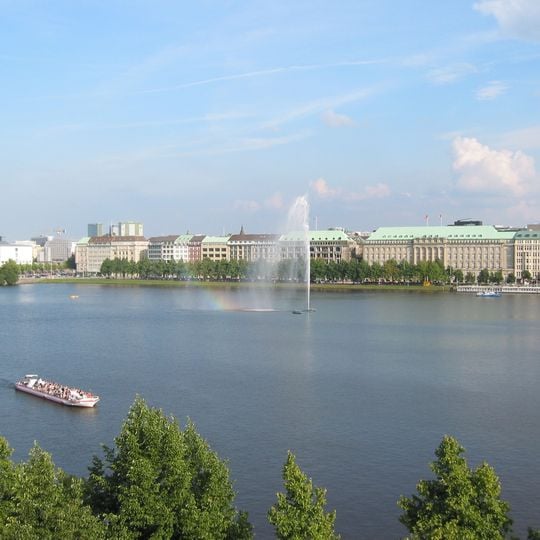
Binnenalster, Urban reservoir in Hamburg-Mitte, Germany.
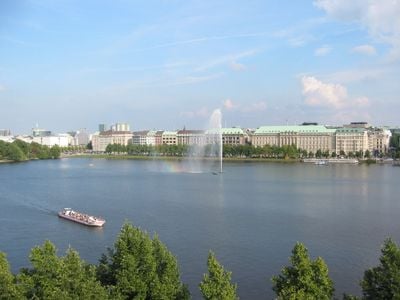
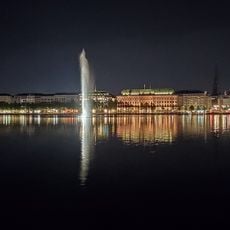
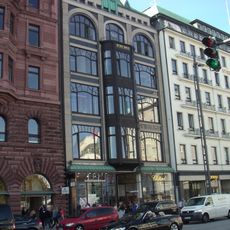
The Binnenalster is the smaller of the two artificial lakes the Alster river forms in central Hamburg, covering 0.2 square kilometres. Embankment streets border it on three sides and a park on the north; the Jungfernstieg runs along the south, with Ballindamm and Neuer Jungfernstieg to the left and right. A single fountain jet rises near the middle of the water.
The Alstersee was created in 1235 under Count Adolf IV of Schauenburg and Holstein by damming the Alster to drive a large grain mill; the flooded Alster meadows became the lake. The dam, named Reesedamm after mill tenant Reese, was widened into today's Jungfernstieg. Hamburg's ramparts of 1616–1625 split the mill pond into Binnenalster and Außenalster, with a wooden bridge and a chained floating log as a barrier.
The Jungfernstieg on the south shore began as the Reesedamm, the mill dam widened into today's boulevard. Each year the Alstervergnügen street fair fills the lake's edge over the first weekend of September with food, drink and games stands and rock bands. The name Alster goes back to an old Indo-European root meaning "water" or "river".
The lake is surrounded by well-developed walking paths that allow you to stroll in any direction while keeping views of the water. The Jungfernstieg station provides immediate access to public transportation for those arriving by transit.
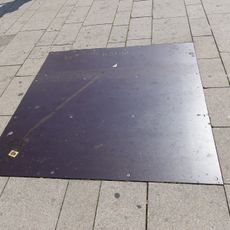
During World War II the lake was covered with a mostly wooden camouflage surface and a fake Lombardsbrücke was added to the Außenalster, so that bomber crews would mistake the water for built-up inner city and drop their bombs there instead.
The community of curious travelers
AroundUs brings together thousands of curated places, local tips, and hidden gems, enriched daily by 94,643 contributors worldwide.