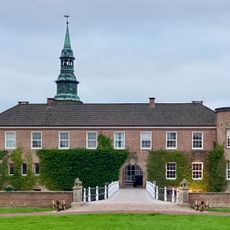
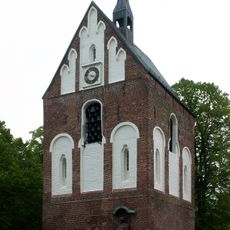
Schlosspark Lütetsburg, Private English landscape garden in Lütetsburg, Germany.
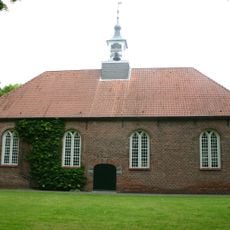
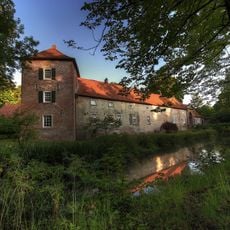
Schlosspark Lütetsburg is a private English landscape garden of about 30 hectares in East Frisia, the largest of its kind in northern Germany. Its winding watercourses, islands, bridges and reed-roofed garden buildings reflect Chinese garden influence, while the excavated earth from the lakes and ditches was piled into the Unico-Hügel, one of East Frisia's highest elevations. A roughly five-kilometre network of paths leads through the grounds.
The grounds were initially laid out in Dutch Baroque style during the early 18th century before Carl Ferdinand Bosse redesigned them between 1790 and 1813. This transformation marked a shift from rigid formal gardens toward a more natural, English landscape garden approach.
The park holds several memorials commissioned by Edzard Moritz zu Innhausen und Knyphausen: a stone pyramid of 1793 on the Island of the Blessed, where deceased family members are buried at sunrise, the Temple of Nature for his wife, and the Caroline Island commemorating his daughter. The round tea house, the Temple of Friendship, contains a medallion portrait of his friend Johann Ludwig Ransleben, a Prussian finance official.
The park is easy to explore on foot, with clearly marked paths and relatively level terrain throughout. Shaded areas and benches are scattered across the grounds, making it comfortable for visitors to rest during their walk.
The park transforms seasonally through the Illumina light art festival, where trees and installations glow after dark. This event gives visitors an entirely different experience of spaces they might have walked through during daylight hours.
The community of curious travelers
AroundUs brings together thousands of curated places, local tips, and hidden gems, enriched daily by 94,600 contributors worldwide.