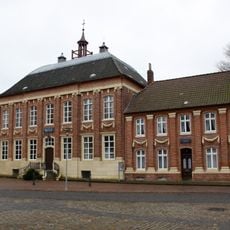
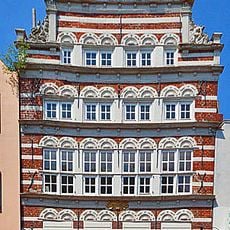
Dree Süsters, Renaissance building ensemble in Norden, Germany.
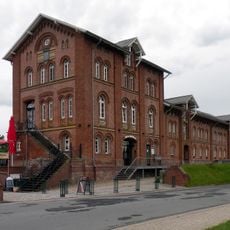
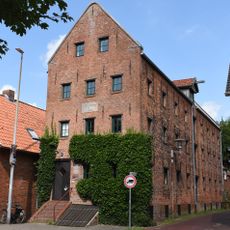
Dree Süsters is an ensemble of three connected brick houses with steeply pitched gables in Norden. The buildings feature stone ornaments and distinctive circular segments in the masonry, along with sandstone bands that accent the facade.
The left building dates from 1570, while the middle and right structures were constructed around 1630, marking the transition from Gothic to Renaissance style. Sandstone bands decorating the facade received renovations in the 17th century to update the buildings' appearance.
The name Dree Süsters is Low German for "Three Sisters", given because the gables look so alike. In the centre of each gable sits a circular segment of diamond-faced masonry holding a ceramic plate: a Delft tile in the two surviving houses, a Harlingen plate in the reconstructed No. 14.
The rightmost building was reconstructed in 1991 to house the tourist information office after being demolished in 1963 for a parking space. This reconstruction allows visitors to explore the ensemble from the outside and access information from the interior.
The right-hand house at No. 14 was demolished around 1963 for a car park; its gable was rebuilt in 1991 from old photographs for use as a tourist office. The two surviving gables form a double house, and the left one mixes Gothic and Renaissance forms: its stepped gable has quarter-circles set into the steps, an early move toward the curved gable fully developed on the middle house.
The community of curious travelers
AroundUs brings together thousands of curated places, local tips, and hidden gems, enriched daily by 93,726 contributors worldwide.