Grüne Brücke Neesen, Railway bridge ruins in Porta Westfalica, Germany.
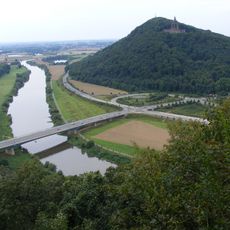
The Grüne Brücke Neesen is a former railway bridge that crosses the Weser River with 21 concrete pillars and a steel arch design reinforced with additional beams. The structure extends across a considerable distance and now appears as ruins within the river valley.
Construction began in 1938 to carry iron ore shipments, but damage during World War II destroyed an eastern pillar and caused the bridge to tilt toward the river. It continued operating after the war before finally closing in 1976.
The bridge owes its name to the green anti-corrosion paint applied when it was built in 1938. Since the ore mine closed in 1963 and the line was shut in 1976, it has stood unused over the Weser, and a cycle path across it has repeatedly been discussed.
The bridge itself is neither passable nor walkable, and the embankments on the western Weser bank have been cut and removed in several places for road construction. A cycle path over the structure has only been discussed repeatedly, never built. The surviving steel span is best viewed from the riverbanks and from the Weser landscape around Neesen and Barkhausen.
During the 1950s, the bridge carried special trains for heads of state and dignitaries, including King Paul of Greece and German Chancellor Adenauer. These high-profile journeys highlight how important the route was before it closed.
The community of curious travelers
AroundUs brings together thousands of curated places, local tips, and hidden gems, enriched daily by 93,441 contributors worldwide.